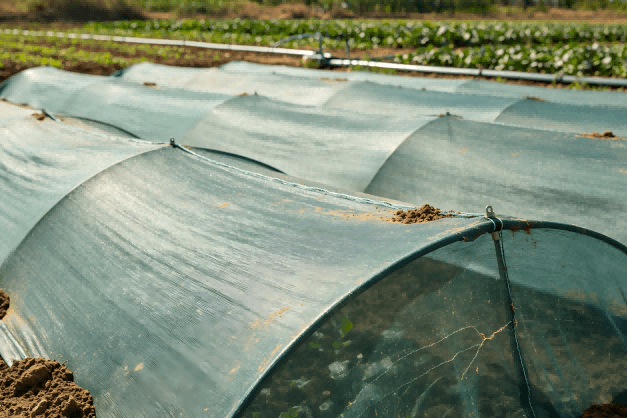
High-Density Polyethylene (HDPE) is the industry standard for long-term commercial crop protection because its linear molecular geometry perfectly integrates with advanced chemical UV stabilizers. When exposed to severe solar radiation, standard plastics undergo rapid photo-oxidation, leading to polymer chain cleavage, structural embrittlement, and catastrophic field failure. By utilizing a 100% virgin HDPE matrix compounded with Hindered Amine Light Stabilizers (HALS), premium agricultural textiles actively neutralize the free radicals generated by ultraviolet photons. This unique chemical synergy grants the Shade Net exceptional thermodynamic stability, allowing it to maintain over 90% of its original tensile strength for five to seven years under continuous, extreme outdoor exposure.
Table of Contents
The Physics of Solar Degradation in Agricultural Polymers
Agricultural infrastructure deployed in open fields or high-altitude environments is subjected to relentless bombardment by solar ultraviolet (UV) radiation. Specifically, UV-A (315–400 nm) and UV-B (280–315 nm) wavelengths carry sufficient quantum energy to break the covalent bonds within synthetic polymers. When standard, unformulated plastics absorb these high-energy photons, they undergo a destructive chemical reaction known as photo-oxidation.
During photo-oxidation, the UV energy forces the polymer’s carbon-hydrogen bonds to rupture, generating highly reactive free radicals. These radicals immediately react with atmospheric oxygen to form peroxyl radicals, triggering a cascading chain reaction of polymer chain cleavage. As the long molecular chains snap into smaller fragments, the material undergoes severe macroscopic changes: the surface exhibits a chalky white residue, the polymer loses its natural multidirectional elasticity, and the mechanical load-bearing capacity drops drastically.
Within months of exposure, an unprotected plastic canopy will become brittle. When subjected to subsequent mechanical stress—such as dynamic wind flutter or heavy rain—the weakened textile will shatter, causing catastrophic canopy failure. Preventing this chain cleavage is the fundamental requirement for any commercial Outdoor Shade Net utilized in enterprise-scale agriculture.
The Molecular Superiority of High-Density Polyethylene
To combat severe environmental weathering, the base resin of the protective mesh must possess inherent structural toughness. High-Density Polyethylene (HDPE) dominates the commercial agricultural textile market because of its unique macromolecular architecture.
Unlike Low-Density Polyethylene (LDPE), which features a highly branched molecular structure, HDPE is characterized by long, linear hydrocarbon chains with minimal branching. This linearity allows the polymer molecules to pack tightly together, creating a dense, highly crystalline microscopic framework. This dense packing results in exceptional tensile strength retention and superior resistance to environmental stress cracking.
Furthermore, HDPE operates as a completely hydrophobic matrix. It exhibits a moisture absorption rate of less than 0.01%. In tropical or high-humidity agricultural settings, organic materials or inferior plastics absorb ambient moisture, which acts as a catalyst for rot, mildew, and accelerated bacterial degradation. Because HDPE repels water entirely, its internal molecular bonds remain isolated from aqueous chemical degradation, ensuring that its mechanical properties stay stable regardless of extreme rainfall or localized humidity spikes inside greenhouse environments.
Engineering Immunity: The Mechanics of HALS Additives
While virgin HDPE provides a robust physical foundation, it still requires chemical reinforcement to survive years of direct UV bombardment. Industrial longevity is achieved by compounding the raw HDPE resin with specialized chemical additives prior to the extrusion process. The most advanced and effective of these additives are Hindered Amine Light Stabilizers (HALS).
Traditional UV absorbers, such as carbon black or benzophenones, function by absorbing UV radiation and dissipating it as low-level thermal energy. However, these absorbers are consumable; over time, they deplete, leaving the polymer exposed. HALS operates on a completely different chemical principle. Instead of absorbing light, HALS acts as highly efficient free radical scavengers.
When a UV photon breaks a polymer bond and creates a destructive free radical, the HALS molecule instantly intercepts and neutralizes the radical before it can propagate through the material. Through a highly efficient chemical mechanism known as the Denisov Cycle, the HALS molecule regenerates itself after neutralizing the threat. This continuous, cyclical regeneration process provides the Agricultural Shade Net with active, long-lasting immunity against photo-oxidation, drastically extending the field lifespan of the canopy in extreme solar environments.
Comparative Material Science Data
Evaluating alternative commercial plastics demonstrates why HDPE remains the undisputed standard for tensioned agricultural canopies and heavy-duty environmental screening.
| Material Parameter | High-Density Polyethylene (HDPE) | Polypropylene (PP) | Polyvinyl Chloride (PVC) |
|---|---|---|---|
| UV Resistance (with HALS) | Excellent. 5 to 7+ years continuous field exposure. | Poor. Highly susceptible to rapid photo-oxidation. | Moderate. Prone to plasticizer migration and stiffening. |
| Moisture Absorption Rate | < 0.01% (Highly hydrophobic, rot-proof). | < 0.05% (Resists rot but degrades in UV). | 0.2% – 0.5% (Can support algae and mold growth). |
| Cold Temperature Tolerance | Retains high elasticity down to -40°C. | Becomes brittle and shatters below 0°C. | Stiffens significantly and cracks in freezing conditions. |
| Agrochemical Resistance | Inert to sulfur evaporators, fertilizers, and pesticides. | Moderate resistance to standard agrochemicals. | Vulnerable to solvent-based pesticides. |
Enterprise Quality Control: The Xinhang Standard
Theoretical material advantages only translate into field reliability if manufacturing protocols are strictly governed. The global market is saturated with low-grade fabrics extruded from regrind or recycled plastics. Recycled HDPE contains pre-broken polymer chains, thermal degradation history from previous melting cycles, and microscopic heavy metal impurities that act as catalysts for rapid UV degradation.
As a verified, premier Shade Net manufacturer located in Lizhuang—the epicenter of China’s advanced netting industry—Xinhang engineers commercial textiles exclusively utilizing 100% virgin HDPE masterbatches. By pairing pure base resins with premium UV-stabilizer packages, the resulting extrusion yields filaments with flawless structural continuity.
Furthermore, these stabilized filaments are processed using advanced warp-knitting technology to create a lockstitch topography. This dynamic architecture ensures that even if heavy hail or machinery punctures the canopy, the tear is isolated to a single micro-loop, preventing catastrophic unravelling. Coupled with precise dimensional extrusion to prevent heat-shrinkage, Xinhang provides international agricultural operators with an unmatched, one-stop procurement solution that truly defends the dignity of their infrastructure investments.
Frequently Asked Questions (FAQ)
Q1: Why is virgin HDPE drastically superior to recycled HDPE for UV protection?
Recycled HDPE has already been subjected to thermal stress during its initial manufacturing and subsequent remelting. This thermal history breaks down the long linear hydrocarbon chains, severely reducing the material’s structural density. Additionally, recycled plastics contain microscopic impurities that catalyze photo-oxidation, causing the net to become brittle and fail within 12 to 18 months, regardless of added UV stabilizers.
Q2: What is the expected lifespan of a commercial-grade HDPE shade net?
When manufactured with 100% virgin HDPE and properly compounded with high-quality Hindered Amine Light Stabilizers (HALS), a commercial net is engineered to maintain over 90% of its tensile strength for 5 to 7 years in high-radiation zones. In moderate climates with proper off-season storage, the operational lifespan frequently extends beyond 10 years.
Q3: Does the color of the HDPE net affect its UV resistance capabilities?
Yes. Black nets are inherently highly UV resistant because carbon black pigment acts as a natural UV absorber, converting solar radiation into safe thermal energy. However, through the integration of HALS technology, modern manufacturers can produce white, green, or aluminized HDPE nets that offer identical UV longevity without the heat-retention characteristics of black fabrics.
Q4: What is the QUV accelerated weathering test mentioned in procurement specs?
The QUV test is an industrial laboratory procedure used to simulate years of outdoor weather damage in a matter of weeks. Fabric samples are exposed to alternating cycles of intense UV fluorescent radiation and condensing moisture at elevated, controlled temperatures. Passing stringent QUV benchmarks guarantees the net’s chemical formulation will survive extreme real-world climates.
Q5: Can standard agrochemicals degrade the UV stabilizers inside the HDPE matrix?
Certain aggressive chemicals, specifically halogenated disinfectants and high-concentration sulfur vapors used in greenhouse pest management, can chemically deactivate HALS additives. However, virgin HDPE is naturally chemically inert. For operations relying heavily on sulfur burners, manufacturers can adjust the additive package with specialized sulfur-resistant HALS variants to ensure the polymer remains protected.
Q6: How does HDPE netting perform in environments experiencing extreme temperature fluctuations?
HDPE possesses extraordinary thermodynamic stability. Unlike Polypropylene (PP) or PVC, which stiffen and shatter in freezing weather, HDPE retains its multidirectional elasticity and impact resistance in temperatures dropping to -40°C. Concurrently, its high melting point allows it to operate flawlessly in extreme desert climates reaching +80°C ambient temperatures without softening or deforming.
References & Technical Standards:
- Polymer Degradation and Photo-Oxidation Mechanics: Farm Plastic Supply Material Science Documentation
- Hindered Amine Light Stabilizers (HALS) Efficiency Data: Greenhouse Megastore UV Treatment Guide
- HDPE Chemical Inertness and Agricultural Applications: Greenpro Ventures Polymer Evaluation