Custom size Shade Net solutions are more cost-effective for large-scale greenhouses because they eliminate the compounded expenses of on-site fabrication labor, massive material wastage from overlapping seams, and the long-term structural failures associated with field-trimmed edges. While off-the-shelf rolls appear cheaper at the point of purchase, the hidden costs—including manual cutting time, the purchase of field-fastening hardware, and the inevitable 10–15% material loss—drastically inflate the project’s total cost of ownership. By procuring factory-finished panels engineered to match specific greenhouse structural dimensions, commercial growers receive a tension-ready, UV-stabilized canopy that ensures zero waste, structural stability under high wind loads, and a significantly extended operational lifespan, offering a superior return on investment for multi-hectare agricultural facilities.
Table of Contents
- 1. The True Cost of “Off-the-Shelf” Bulk Procurement
- 2. Eliminating Material Waste Through Precision CAD Fabrication
- 3. Structural Integrity: Factory-Finished Selvedges vs. Field-Trimmed Edges
- 4. Engineering Labor Efficiency in Large-Scale Installations
- 5. Commercial Data: Waste Mitigation and ROI Comparison
- 6. Frequently Asked Questions (FAQ)
The True Cost of “Off-the-Shelf” Bulk Procurement
Many enterprise procurement directors initially view generic, bulk-roll Agricultural Shade Net as the most economical choice. However, this perspective ignores the “total installed cost” reality of professional agricultural projects. Generic rolls are manufactured in standardized widths, rarely matching the complex, multi-span geometry of modern large-scale greenhouse structures.
To force a generic roll to fit a custom greenhouse, field crews must engage in extensive measuring, manual cutting, and on-site hemming. This process consumes hundreds of man-hours, introduces human error in alignment, and inevitably results in significant fabric remnants that cannot be used. When these hidden costs of specialized on-site labor and material disposal are factored into the balance sheet, the initial “savings” of generic procurement often disappear, leaving the facility with an amateurish, structurally vulnerable canopy.
Eliminating Material Waste Through Precision CAD Fabrication
Precision manufacturing transforms the procurement model from an unpredictable bulk purchase to a systematic engineering solution. By utilizing CAD-based panel cutting, manufacturers can map the entire greenhouse roof structure, accounting for every curve, ridge, and gutter, to create modular panels that align perfectly with the support grid.
This approach maximizes the utilization of every square meter of high-grade High-Density Polyethylene (HDPE). Instead of overlapping fabric by 50 cm to create manual seams in the field—a practice that wastes massive amounts of material—factory-fabricated panels utilize high-strength, machine-sewn double lockstitch seams with a minimal, optimized overlap. For multi-hectare projects, this precision reduces raw material requirements by as much as 10% to 15%, which, at enterprise volumes, generates significant immediate CapEx savings.
Structural Integrity: Factory-Finished Selvedges vs. Field-Trimmed Edges
The edge of the netting is its most vulnerable structural point. When a roll is cut on-site, the structural selvedge (the sealed, reinforced edge that prevents unravelling) is destroyed. The resulting raw edge contains thousands of micro-filaments exposed to aerodynamic flutter, friction, and tension.
Under high wind loads, these raw edges unravel within weeks, leading to catastrophic panel failure. Conversely, factory-finished panels arrive with heavy-duty polyester webbing tape heat-sealed and machine-stitched along every perimeter. This edge reinforcement acts as a structural spine, distributing the mounting tension across the entire edge rather than straining individual mesh loops. This prevents tear propagation, ensuring the canopy remains securely fastened even in extreme high-wind environments, further protecting the facility’s long-term infrastructure investment.
Engineering Labor Efficiency in Large-Scale Installations
Operational speed is a primary driver of cost-efficiency. Field-fabricated installations require skilled labor to perform technical work (hemming, grommeting, seam-stitching) under challenging outdoor conditions. This introduces the high probability of inconsistent seams and alignment errors.
Factory-fabricated solutions are “plug-and-play.” Each section is clearly marked (e.g., “North-Span-Ridge-Panel”), allowing installation crews to immediately lift and secure the panels to the structure. This drastic reduction in on-site labor time minimizes the duration of site closures, prevents weather-related installation delays, and ensures that the system is installed to factory-verified tension standards from day one, drastically extending the effective lifecycle of the Outdoor Shade Net canopy.
Commercial Data: Waste Mitigation and ROI Comparison
The following matrix compares the lifecycle economic impacts of raw-roll procurement versus custom-fabricated engineering.
| Metric | Raw Roll Procurement | Factory Custom-Panel |
|---|---|---|
| Material Waste Factor | 12% – 18% (Overlaps & Trims). | < 1% (Precision Nesting). |
| Site Labor Hours | Very High (Fab + Inst). | Low (Hoisting + Securing). |
| Structural Failure Risk | High (Frayed raw edges). | Low (Webbed/Sealed borders). |
| Lifecycle Longevity | 2 – 3 Years. | 5 – 10 Years. |
Sourcing Strategy: Manufacturer Direct vs. Trading
To capture the economic benefits of custom paneling, enterprise project managers must contract directly with production facilities. Intermediary trading companies routinely fail to provide structural continuity, supplying nets that are not dimensionally heat-set, leading to the “shrinkage effect” where panels contract after installation and tear their mounting hardware.
As a globally verified Shade Net manufacturer based in the industrial center of Lizhuang, Xinhang offers complete vertical control. Our facility manages the extrusion of 100% virgin HDPE, the precise warp-knitting of the lockstitch matrix, and the custom industrial sewing of your panel borders. By bypassing middlemen, our clients verify quality at the source, ensure GSM and UV-stabilization compliance, and receive factory-finished panels that align perfectly with their CAD structural layouts. Xinhang’s direct-to-site supply chain is engineered to eliminate waste and deliver unmatched infrastructure performance.
Frequently Asked Questions (FAQ)
Q1: How do I measure my greenhouse to avoid ordering oversized panels?
Measure the physical arc length of your hoops rather than the ground width. Always subtract 1.5% to 3% as a tension allowance. If you are unsure, provide your structural blueprints to our engineering team, and we will calculate the fabrication dimensions to ensure a drum-tight fit without excess material.
Q2: What happens if the shade net shrinks after installation?
Shrinkage occurs when manufacturers do not thermally anneal (heat-set) the net after extrusion. Xinhang guarantees dimensional stability by heat-setting our panels, ensuring that your installation maintains its shape and tension even in extreme summer heat.
Q3: How much lead time should I allow for custom fabrication?
Because fabrication involves custom CAD patterning, precision sewing, and structural reinforcement, custom-finished panels require longer lead times than generic rolls. We advise B2B procurement teams to submit their technical specifications at least 30 to 45 days prior to the desired on-site installation date.
Q4: Can Xinhang manufacture panels with specific grommet spacing?
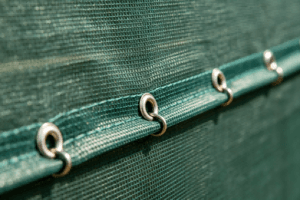
Yes. We can customize grommet placement to align perfectly with your existing support cable grid or mounting brackets. Simply include a grommet positioning diagram in your technical specification package, and our fabrication team will ensure every hole is punched through the reinforced webbing tape.
Q5: Is it possible to splice panels if my greenhouse span is exceptionally wide?
Yes. Our industrial facility uses heavy-duty multi-needle machines to join panels with reinforced, double-lockstitch seams. This is far more durable than overlapping rolls in the field. We optimize the panel seams to ensure the strength is consistent across the entire span of the roof.
References & Technical Standards:
- CAD Modeling and Structural Specification Protocols: Shade Cloth Store Fabrication Guidelines
- ASTM Polymer Tensile Elongation and Stability Metrics: Greenhouse Megastore Procurement Specs
- Warp-Knitted Mesh Tensioning and Aerodynamic Modeling: Farm Plastic Supply Field Implementation