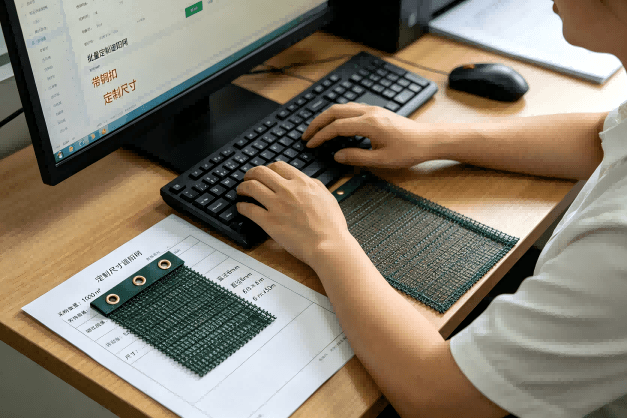
Ordering bulk custom-sized Shade Net with factory-installed brass grommets is a strategic procurement decision that shifts the fabrication burden from on-site labor to specialized manufacturing lines. B2B buyers must avoid generic retail rolls—which lack structural edge reinforcement—in favor of factory-finished, tension-ready panels. A successful wholesale order requires the submission of a rigorous technical specification package (TSP) detailing exact dimensions, edge webbing widths, grommet intervals, and polymer stabilization requirements. By aligning your CAD-based structural layout with the manufacturer’s production capabilities, you eliminate on-site material waste and guarantee that every custom panel possesses the tensile load distribution necessary to survive extreme climatic environments for 5 to 10 years.
Table of Contents
- 1. The Strategic Advantage of Factory-Finished Panels
- 2. Defining Your Specification: The Technical Audit
- 3. Engineering the Grommet Interface
- 4. Verifying Polymer Purity and UV Stabilization
- 5. Commercial Procurement Workflow Matrix
- 6. Sourcing Direct: The Manufacturer-to-Client Model
- 7. Bulk Procurement FAQ
The Strategic Advantage of Factory-Finished Panels
Retail-grade shade nets are designed for manual, temporary use, while commercial-grade panels are designed for structural integrity. The primary weakness of bulk, raw-roll procurement is the manual handling required on-site. When laborers cut raw mesh to fit an Agricultural Shade Net structure, they inevitably compromise the factory selvedge.
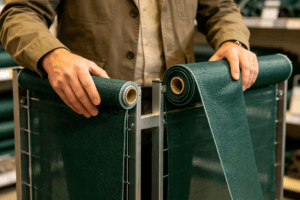
In contrast, factory-finished panels arrive with thermally-set, reinforced edges. By ordering pre-grommeted panels, you shift the fabrication complexity to the factory floor, where hydraulic punching machines and automated industrial sewing lines ensure every attachment point is perfectly positioned and reinforced. This results in an installation that is aerodynamically stable, resistant to line-tear propagation, and dramatically reduces total project labor hours.
Defining Your Specification: The Technical Audit
A successful bulk order begins with a comprehensive technical audit. Before contacting an Shade Net manufacturer, prepare a specification sheet including:
- Netting Type: Specify the shade percentage and the weave (warp-knitted lockstitch is mandatory for high-wind stability).
- Dimensional Layout: Provide the exact “fabric dimensions” (inclusive of tension allowances) and the “mounting dimensions” of the structure.
- Edge Finishing: Specify the width of the polyester webbing (typically 5cm to 8cm) and the location of the border on the perimeter.
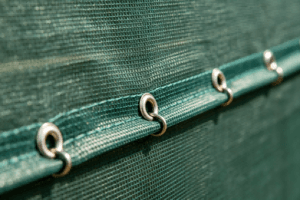
- Hardware Placement: Detail the grommet type (brass is standard for corrosion resistance) and the required intervals (standard 50cm, or 30cm for extreme-wind industrial zones).
Engineering the Grommet Interface
The grommet is the most common point of structural failure. Punching a hole directly into a high-density polyethylene mesh will cause the filaments to tear under the pulling force of the installation cable.
Wholesale procurement must mandate that brass grommets are installed exclusively through reinforced polyester webbing tape. This webbing distributes the mechanical pull force across a larger surface area of the fabric matrix. When ordering in bulk, ensure the webbing is also UV-stabilized. A common failure in low-grade panels is the use of non-stabilized webbing that disintegrates under intense UV exposure while the shade netting itself remains intact, rendering the panel useless.
Verifying Polymer Purity and UV Stabilization
Bulk procurement is a high-stakes investment. If you order 50,000 square meters of material, you must be certain of its chemical composition. Demand proof of 100% virgin High-Density Polyethylene (HDPE). Recycled materials, or “regrind,” contain internal defects that cause rapid brittleness under solar load.
Verify that the HALS (Hindered Amine Light Stabilizers) package is integrated into the polymer matrix during the initial extrusion phase. Reputable manufacturers will provide QUV weather testing results, certifying that the material will maintain 90% of its initial tensile strength even after extended outdoor exposure.
Commercial Procurement Workflow Matrix
Follow this standardized B2B workflow to ensure the delivered product meets the required engineering tolerances.
| Phase | Action Item | Critical Verification |
|---|---|---|
| 1. Specification | Submit CAD layout + TSP. | Verify negative tension allowance. |
| 2. Production | Masterbatch and knit processing. | Confirm virgin HDPE + HALS usage. |
| 3. Quality Control | GSM & Tensile Strength testing. | Validate ASTM D5034 test results. |
| 4. Logistics | Cylindrical rolling and labelling. | Ensure labeling matches CAD layout. |
Sourcing Direct: The Manufacturer-to-Client Model
Wholesale procurement succeeds when the client connects directly with the factory matrix. Intermediaries often struggle with communication lapses regarding the precise structural finish of the netting.
Xinhang, as a direct Shade Net manufacturer based in the industrial center of Lizhuang, provides an end-to-end B2B solution. We eliminate information loss by having our engineering team review your specifications before a single thread is extruded. From compounding virgin HDPE with HALS to custom-sewing the grommet-punched webbing borders, our vertical integration ensures that every panel is optimized for your structural layout. By sourcing direct, you secure high-tensile reliability at factory-direct pricing, ensuring your project is protected by infrastructure that is literally built to your specifications.
Frequently Asked Questions (FAQ)
Q1: Why are brass grommets preferred over stainless steel for these panels?
Brass is highly corrosion-resistant in the damp, chemically charged environments typical of greenhouses and industrial yards. It provides a slightly softer interface than steel, which allows the metal to seat better against the polymer webbing, reducing the risk of point-shear that can occur with harder metals like stainless steel.
Q2: What is the benefit of “factory-seamed” modular panels?
Factory-seamed panels eliminate the need for manual, field-based joining. Our factory uses heavy-duty, multi-needle lockstitch machines that create a structural, weatherproof bond. This is inherently stronger, faster to install, and more durable than any manual, site-improvised overlap seam.
Q3: How do I handle large-scale grommet layout diagrams for the manufacturer?
For large orders, provide the manufacturer with a simple grid overlay showing the perimeter dimensions of your panel and the required grommet placement. Our fabrication team will verify that these intervals align with your support cables, ensuring that no grommet is misplaced during the punching process.
Q4: Is it possible to get fire-retardant (FR) treatment on grommeted panels?
Yes. If your project requires compliance with fire safety codes (e.g., NFPA 701), specify that the base netting must be extruded with FR-additive masterbatches. The reinforcement webbing tape must also be FR-certified to ensure the entire assembly meets regulatory requirements.
Q5: How are custom panels packed for shipping?
Custom panels are tightly folded or rolled and shrink-wrapped into palletized, moisture-proof transport bags. Each bag is labeled to correspond with your structural CAD map, making it easy for the installation crew to identify exactly which panel goes to which section of your facility.
References & Technical Standards:
- CAD Patterning and Industrial Tension Protocols: Shade Cloth Store Custom Engineering
- Polymer Extrusion and UV Stabilization Specs: Greenhouse Megastore Procurement Data
- Warp-Knitted Edge Webbing Mechanics: Farm Plastic Supply Field Implementation