
Commercial growers calculate exact Shade Net dimensions by integrating architectural geometric formulas with the precise tensile elasticity and thermal shrinkage coefficients of the specific polymer mesh. Ordering standard generic rolls for custom multi-span greenhouses or open-field cable grids inevitably leads to excessive manual trimming, overlapping material waste, and severe structural failure under wind loads. To avoid discarding thousands of dollars in unusable fabric, project engineers must calculate the exact arc length of hoop structures, apply a negative tension allowance for lockstitch elasticity, factor in the thermal memory of High-Density Polyethylene (HDPE), and specify factory-finished edge reinforcements. Procuring mathematically optimized, custom-fabricated panels directly from the manufacturing floor eliminates on-site cutting waste and ensures a perfectly tensioned microclimate canopy.
Table of Contents
- 1. Structural Geometry: Mathematical Modeling for Crop Enclosures
- 2. Dynamic Tensile Elongation and Tension Allowances
- 3. Thermal Dimensional Stability and “True-Width” Extrusion
- 4. Edge Reinforcement Logistics and Seam Overlap Engineering
- 5. Commercial Dimensional Calculation Matrix
- 6. Enterprise Custom Fabrication Solutions
- 7. Frequently Asked Questions (FAQ)
Structural Geometry: Mathematical Modeling for Crop Enclosures
The primary cause of material waste in commercial installations is relying on the flat square footage of the ground rather than calculating the true three-dimensional canopy footprint of the support structure. Different architectural designs require distinct geometric calculations.
Gable Roof and A-Frame Calculations
For pitched structures, the protective fabric must travel up the incline to the ridge pole and back down to the opposite gutter. Utilizing the ground width will leave the fabric short. Engineers apply the Pythagorean theorem ($a^2 + b^2 = c^2$) to determine the exact rafter length (hypotenuse).
If a greenhouse is 10 meters wide with a center ridge pole standing 3 meters above the gutter height, the horizontal run ($a$) is 5 meters, and the vertical rise ($b$) is 3 meters. The length of one roof slope ($c$) equals $sqrt{5^2 + 3^2} approx 5.83$ meters. Therefore, the total true width required to cross the structure is $5.83 times 2 = 11.66$ meters. Ordering a standard 10-meter wide roll based on floor space guarantees catastrophic material shortage.
Quonset Hoop and Arch Frame Calculations
High-tunnel hoop houses require calculating the arc length of the curved steel frame. For a perfectly semi-circular hoop, the calculation utilizes half the circumference of a circle ($C = frac{1}{2} pi D$). If the ground width (diameter, $D$) of the tunnel is 8 meters, the necessary fabric width to stretch from ground-to-ground over the arch is approximately $frac{1}{2} times 3.14159 times 8 = 12.56$ meters.
However, most commercial structural arches are not perfect semi-circles; they possess straight side-walls before the curve begins (Gothic arch style). In these cases, the straight side-wall height must be added to the calculated arc length of the roof section to determine the final cross-sectional dimension.
Dynamic Tensile Elongation and Tension Allowances
Mathematical geometric measurements provide the baseline structural size, but they do not account for the physical behavior of the polymer mesh. Premium Agricultural Shade Net relies on a warp-knitted architecture, which possesses inherent multidirectional elasticity. When this material is installed, it must be pulled tight to engage its structural load-bearing capabilities.
If an operator orders the exact geometric dimensions, the knitted fabric will sag loosely over the frame. Loose fabric causes wind flutter, leading to rapid mechanical chafing against the steel hoops. To achieve a taut, professional fit, procurement teams must apply a negative tension allowance based on the fabric’s tensile elongation rate.
- Knitted Mesh Elongation: High-density lockstitch knitted fabrics generally exhibit an elasticity rate of 1.5% to 3% under installation tension. Therefore, if the structural length is 100 meters, the fabric panel should be ordered at 97.5 to 98.5 meters. The installers will mechanically stretch this shorter panel across the frame, creating a drum-tight canopy that actively resists aerodynamic drag.
- Woven Mesh Rigidity: Traditional woven nets possess almost zero lateral elasticity. For woven materials, negative tension allowances must be avoided. Woven panels should be ordered exactly to the structural geometry, plus a small positive allowance for attachment wrapping, as they cannot be stretched over gaps.
Thermal Dimensional Stability and “True-Width” Extrusion
High-Density Polyethylene (HDPE) reacts thermodynamically to ambient temperature changes. In extreme heat, the polymer filaments soften and expand slightly; during cold nights, they contract. Professional mesh must be manufactured with a minimal thermal shrinkage rate (typically engineered to remain under 1.5% at 60°C).
A major source of dimensional waste in the agricultural sector stems from deceptive manufacturing practices known as “stretched-width processing.” Low-tier suppliers often take a net extruded at 6 meters wide and forcefully stretch it onto an 8-meter roller to sell it at a higher premium. This forces the polymer molecules into an unnatural state of tension.
When the buyer installs this stretched net in an open field, the intense summer sun resets the polymer memory. The fabric aggressively shrinks back to its original 6-meter width, ripping attachment grommets from the support cables and leaving massive gaps in the canopy. Partnering with a verified Shade Net manufacturer like Xinhang guarantees true-width extrusion. Our machinery is calibrated to extrude and set the fabric exactly at the specified target width through controlled thermal annealing, ensuring absolute dimensional stability in the field.
Edge Reinforcement Logistics and Seam Overlap Engineering
Unfinished raw edges cannot support tension. Whenever fabric is cut on-site, the raw edges must be rolled and clamped, which consumes up to 30 cm of material per edge. Across a multi-acre facility, these manual hems result in hundreds of meters of wasted material.
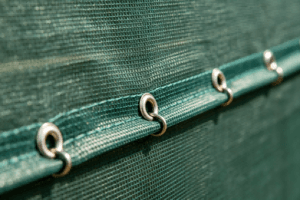
Precision procurement eliminates this by incorporating selvedge reinforcement directly into the manufacturer’s CAD specifications. When calculating final dimensions, engineers must account for the width of the heavy-duty webbing (usually 5 cm to 8 cm) and the spacing of the brass grommets.
Furthermore, when covering vast acreages that exceed maximum extrusion widths, multiple panels must be joined. Rather than ordering raw rolls and overlapping them by 50 cm on-site (a massive waste of square footage), commercial growers calculate the exact dimensions and order factory-sewn modular panels. Factory seaming utilizes UV-stabilized thread to join panels edge-to-edge with a minimal 5 cm overlap, optimizing total material usage and guaranteeing uniform mechanical load distribution across the entire joint.
Commercial Dimensional Calculation Matrix
The following matrix outlines the standardized adjustment factors required to translate structural ground measurements into highly accurate procurement dimensions.
| Structural Framework | Core Geometric Formula | Knitted Mesh Tension Allowance | Waste Mitigation Strategy |
|---|---|---|---|
| Flat Tensioned Cable Grid | Length $times$ Width (Perimeter boundaries) | Deduct 1.5% to 2% from target dimension. | Order factory-taped edges with pre-punched grommets aligned to cable spacing. |
| A-Frame / Pitched Roof | Pythagorean Theorem: $sqrt{text{Rise}^2 + text{Run}^2} times 2$ | Deduct 1% (Rigid rafters restrict excessive stretch). | Calculate exact hypotenuse to avoid excess fabric pooling in the gutters. |
| Semi-Circular Hoop House | Arc Length: $frac{1}{2} pi times text{Diameter}$ | Deduct 2% to 3% for secure arch tensioning. | Measure directly over the arch hoop with a flexible tape to account for pipe thickness. |
| Automated Retractable Roof | Exact track-to-track interior measurements. | Zero deduction. Must fit track specs exactly. | Specify zero-shrinkage heat-set polymer to prevent track binding. |
Enterprise Custom Fabrication Solutions
Purchasing generic 50-meter rolls and deploying field laborers with shears is the most inefficient procurement method in modern agriculture. Off-cuts, misaligned seams, and frayed edges inevitably result in up to 15% material waste per hectare.
Xinhang resolves this by operating as a direct-from-factory customization hub. We collaborate with structural engineers to take your precise architectural CAD measurements and translate them into ready-to-deploy modular panels. Every Outdoor Shade Net leaves our Lizhuang facility pre-shrunk, pre-tensioned, heavily reinforced at the borders, and sized perfectly to match your structural parameters. This “plug-and-play” delivery eliminates on-site cutting, slashes installation labor costs by up to 40%, and ensures absolute zero fabric waste.
Frequently Asked Questions (FAQ)
Q1: Why do I need to deduct length when ordering a knitted shade net?
Knitted netting features an interlocking lockstitch structure that acts like a micro-spring. If you order the exact physical dimensions of your frame, the net will lack tension when installed, causing it to sag and flutter violently in the wind. Deducting 1.5% to 3% allows