Edge reinforcement is the single most critical structural specification for custom-sized Shade Net procurement, serving as the primary load-bearing interface between the flexible polymer mesh and the rigid structural framework. In large-scale agricultural and industrial environments, high-velocity wind shear exerts massive lateral pressure on the net’s perimeter; without factory-engineered webbing and grommet systems, this tension inevitably concentrates on individual micro-filaments, leading to rapid line-tear propagation and structural collapse. By specifying industrial-grade perimeter reinforcements—such as multi-layered polyester webbing, heavy-duty heat-set selvedges, and high-tensile brass grommets—enterprise buyers ensure that mechanical stress is evenly distributed across the entire canopy, guaranteeing the durability of custom panels against extreme climatic conditions.
Table of Contents
- 1. The Physics of Perimeter Stress Distribution
- 2. Webbing and Selvedge Engineering Standards
- 3. Grommet and Hardware Integration Mechanics
- 4. Preventing Line-Tear Propagation in Knitted HDPE
- 5. Commercial Data: Edge Reinforcement Comparison Matrix
- 6. Enterprise Procurement and Factory Fabrication Advantages
- 7. Edge Reinforcement Frequently Asked Questions (FAQ)
The Physics of Perimeter Stress Distribution
In any high-tension application, the weakest point of the structural system is the transition zone where the soft, flexible mesh is secured to the hard, unyielding support poles. When wind currents impact a massive canopy, the air pressure generates a drag coefficient that pulls the entire surface toward the leeward direction.
Without reinforcement, this force is not distributed; it is concentrated into singular, pin-point stresses at every individual attachment fastener. If you punch a grommet directly into the raw, unreinforced mesh, the tensile load will inevitably slice through the individual HDPE filaments. This leads to “grommet pull-out,” where the fastener shears cleanly through the netting. By utilizing a reinforced edge (selvedge), the tensile load is shifted from the delicate filaments to the industrial-strength polyester webbing, effectively creating a structural spine that enables the netting to support thousands of Newtons of force without material failure.
Webbing and Selvedge Engineering Standards
Professional-grade edge reinforcement utilizes specialized materials specifically designed for long-term outdoor survival.
- Poly-Webbing Reinforcement: Heavy-duty polyester or polypropylene tape is folded over the mesh edge, creating a multi-layered barrier. Polyester webbing is preferred in high-UV regions for its superior photo-oxidation resistance compared to nylon, which degrades quickly when exposed to sunlight.
- Lockstitch Border Stitched Seams: The webbing is attached using high-speed, industrial lockstitch sewing machines. Unlike a standard chain stitch, which unravels if a single thread is broken, a lockstitch is structurally locked; even if a section of the thread is frayed by abrasion, the remaining stitch continues to secure the webbing to the netting matrix.
- Heat-Set Selvedges: Before the webbing is applied, the edge of the knitted HDPE mesh itself is heat-set and trimmed. This creates a semi-rigid border that is less likely to curl or bunch inside the webbing tape, ensuring a uniform seam that can maintain constant structural tension over multi-year cycles.
Grommet and Hardware Integration Mechanics
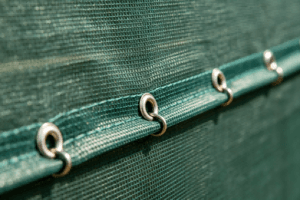
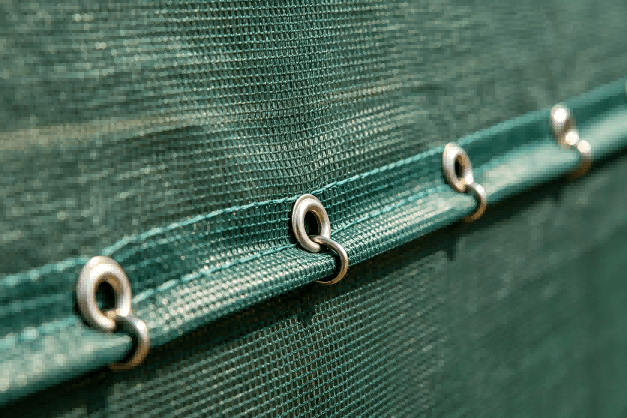
The hardware integration is the final link in the load-bearing chain. Grommets, or eyelets, are the critical interface between the fabric and the support cables or bungee fasteners.
In commercial construction and Agricultural Shade Net applications, only industrial-grade brass or high-grade stainless steel grommets should be specified. Cheap, plastic, or low-grade iron grommets will either snap under high wind tension or corrode rapidly in humid, agricultural environments.
Crucially, the grommet must always be installed through the webbing tape, not the raw net. The webbing is folded into a “sandwich” of fabric layers, and the grommet is hydraulically stamped through this thick layer of material. This creates a high-pressure mechanical bond that distributes the force of the attachment carabiner or cable over the entire diameter of the grommet, effectively nullifying the risk of a single filament tear.
Preventing Line-Tear Propagation in Knitted HDPE
The structural topography of the netting itself acts as the first line of defense in edge protection. High-performance nets utilize a warp-knitted lockstitch matrix. This pattern consists of continuous, interlocking loops of polymer filament.
When an edge is correctly reinforced with webbing, the lockstitch pattern ensures that any localized tension is distributed across thousands of loops. If a grommet is stressed, the loop-and-lock structure spreads the force across the adjacent rows, preventing the mesh from “running” (line-tear propagation). This is the fundamental advantage of knitted over woven mesh in high-wind zones; in a woven fabric, the perpendicular threads cannot share the load, and a tear starting at the edge will rapidly migrate across the entire panel under the force of the wind.
Commercial Data: Edge Reinforcement Comparison Matrix
The following matrix illustrates the performance impact of different perimeter finishing techniques in industrial-scale deployments.
| Border Finishing Strategy | Tensile Capacity (Edge) | Aerodynamic Load Limit | Operational Suitability |
|---|---|---|---|
| Raw/Heat-Cut Edge | Very Low (Shears instantly). | Minimal. Fails in light breeze. | Temporary, light-duty garden netting. |
| Folded-Over Heat Seal | Moderate (Prone to delamination). | Low. Prone to stretching under heat. | Lightweight greenhouse interior curtains. |
| Polyester Tape Webbing | Very High (Full load distribution). | High. Resists cyclonic wind force. | Commercial agriculture; industrial perimeters. |
Enterprise Procurement: Manufacturer-Direct Customization
Edge reinforcement is a complex engineering task that cannot be effectively replicated by on-site field laborers. Attempting to hem and grommet large-scale netting panels in the field results in uneven tension, high failure rates, and wasted labor.
To secure total site reliability, procurement teams must source factory-finished panels from a verified Shade Net manufacturer. Operating from Lizhuang, Xinhang utilizes fully integrated factory lines to perform the reinforcement process. We take your exact dimensional requirements and fabricate the panels with machine-stitched polyester webbing, precisely aligned grommets, and heat-set selvedges before shipping. This “plug-and-play” manufacturing model eliminates the risk of human error during field installation, ensures that the structural tension is consistent across every hectare, and provides a multi-year, weatherproof canopy that defends against the harshest environmental variables.
Frequently Asked Questions (FAQ)
Q1: Why should I specify brass grommets over stainless steel or plastic?
Brass is highly resistant to corrosive agricultural environments (like salt air or acidic fertilizer sprays) and provides a softer, more pliable metal interface that does not cut into the polymer webbing. While stainless steel is stronger, it is often more expensive and unnecessary; brass provides the ideal balance of corrosion resistance and material compatibility for high-tension canopy applications.
Q2: Can the webbing be color-matched to my commercial facility?
Yes. Custom fabrication allows for the selection of specific polyester webbing colors, such as black, beige, or green, to align with architectural branding. Ensure the webbing material itself is treated with UV inhibitors, just like the net, so that the border does not fade or degrade faster than the canopy fabric.
Q3: What is the recommended grommet spacing for high-wind industrial zones?
For standard installations, 50 cm spacing is the commercial standard. In areas subjected to extreme wind shear (such as coastal industrial lots or high-elevation farms), request grommet spacing to be reduced to 30 cm. This closer interval significantly increases the number of attachment points, effectively lowering the localized tensile stress on each individual grommet.
Q4: Should the webbing be sewn with a single or double-stitch line?
For any commercial or industrial application, a double-lockstitch line is mandatory. A single stitch line is a single point of failure; if one thread breaks, the webbing begins to peel away. A double-lockstitch ensures that the webbing remains securely anchored to the mesh matrix even if one thread line suffers localized abrasion.
Q5: How can I prevent the netting from slipping inside the webbing during high winds?
This is prevented by utilizing a high-tension factory sewing process and ensuring the fabric is “true-width” annealed before the webbing is applied. Xinhang’s fabrication process heat-sets the fabric width, which creates a stable, non-stretching border edge that remains locked securely inside the polyester webbing tape, ensuring the panel doesn’t “creep” or pull away under constant tension.
References & Technical Standards:
- Polymer Structural Dynamics and Tensioning: Farm Plastic Supply Field Implementation
- ASTM D5034 Grab Test and Edge Load Specs: Greenhouse Megastore Engineering Guidelines
- Industrial Warp-Knitting and Perimeter Reinforcement: Greenpro Ventures Mesh Diagnostics