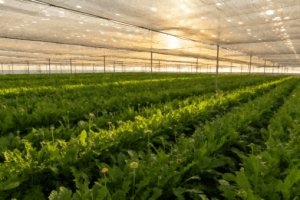
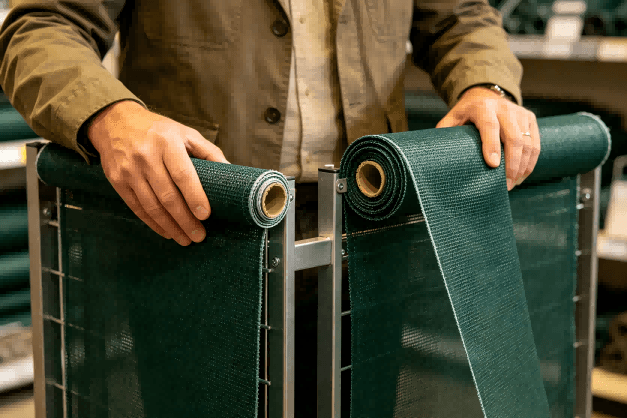
For B2B operations, the choice between standard rolls and custom-sized Shade Net panels represents the difference between a volatile consumable and a permanent, high-performance infrastructure asset. While standard rolls offer lower initial per-unit costs, they impose massive hidden overheads—including extensive on-site fabrication labor, significant material waste from manual trimming, and the structural risks of raw-cut edges. Custom-engineered panels, conversely, are factory-fabricated to exact dimensions, complete with reinforced selvedges and precision grommet placement, effectively eliminating on-site installation errors and tear propagation. For enterprise buyers, custom procurement is mathematically superior, delivering a lower total cost of ownership (TCO) through reduced labor, optimized material usage, and a significantly extended operational lifespan.
Table of Contents
- 1. The Fallacy of the “Lower Price-per-Roll” Metric
- 2. Structural Integrity: Why Factory-Finished Edges Win
- 3. Installation Labor and Logistics Efficiency
- 4. Material Waste Mitigation and CAD-Based Nesting
- 5. Commercial Data: Lifecycle ROI Comparison
- 6. Manufacturer-Direct Procurement Strategy
- 7. Frequently Asked Questions (FAQ) for B2B Buyers
The Fallacy of the “Lower Price-per-Roll” Metric
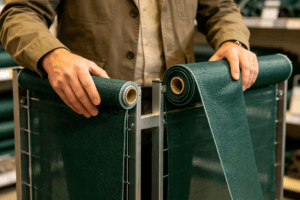
Enterprise procurement teams often fall into the trap of analyzing shade netting based exclusively on the unit price of a standard 50-meter roll. This approach ignores the reality of large-scale installation environments. Standard rolls are designed for retail convenience, not industrial structural requirements.
When an industrial facility or a multi-hectare agricultural operation buys raw rolls, the procurement team must account for the substantial hidden costs that follow: the labor-intensive measuring, the high-precision cutting required to avoid frame collisions, and the necessity of on-site hemming to prevent the mesh from unravelling. In professional Agricultural Shade Net applications, these “hidden” labor costs frequently exceed the initial material savings. Custom-size panels, while carrying a higher purchase price, are delivered ready-to-hoist, effectively neutralizing these secondary expenses and providing a predictable, stable financial model.
Structural Integrity: Why Factory-Finished Edges Win
A high-quality shade net is only as secure as its perimeter. When laborers trim generic netting on-site, they destroy the factory-sealed border (the selvedge). This creates a raw edge—a “frayed frontier”—where thousands of individual High-Density Polyethylene (HDPE) filaments are exposed.
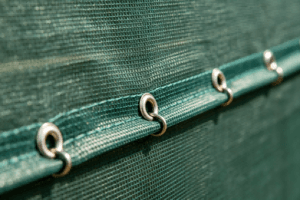
In a high-wind scenario, this raw edge is prone to line-tear propagation. The wind’s kinetic energy catches these loose ends, causing a cascading unravelling that can destroy an entire panel in minutes. Conversely, factory-finished custom panels undergo high-speed machine-stitching, where high-tensile polyester webbing is folded and sewn over the netting border. This creates a structural spine capable of distributing thousands of Newtons of force. By securing the load on this factory-integrated webbing—and not the mesh itself—you guarantee that the canopy remains fastened under extreme environmental stress.
Installation Labor and Logistics Efficiency
Installation speed is a critical B2B metric. Custom-size panels utilize “plug-and-play” logistics: panels are fabricated to match the exact spacing of the existing greenhouse arches or industrial support columns.
During site execution, installation crews move through the facility, hoisting and clipping pre-measured panels into place according to their specific structural location. This eliminates the uncertainty of field measurements and the danger of climbing ladders or scaffolding to trim fabric around support posts. This efficiency isn’t just about speed; it’s about safety. By reducing the time workers spend on high-altitude equipment, enterprise managers significantly lower their on-site insurance and liability risk profile.
Material Waste Mitigation and CAD-Based Nesting
Large-scale greenhouse spans often involve complex geometries—arches, curves, and angles—that do not conform to standardized roll widths. Using generic rolls creates significant “off-cut” waste, where fabric is trimmed and discarded to make the net fit the frame.
Xinhang’s factory fabrication process uses CAD-based panel nesting, where every required section is digitally mapped to minimize trim waste. We utilize every available centimeter of the HDPE master roll. For large orders, this optimization can reduce material consumption by 10% to 15% compared to generic roll-based estimates. When compounded across massive agricultural sites, this reduction in raw material procurement provides a significant, tangible improvement to project ROI.
Commercial Data: Lifecycle ROI Comparison
Enterprise procurement shifts the focus from initial “price-per-roll” to the long-term lifecycle performance of the protective netting.
| ROI Metric | Generic Roll Procurement | Custom Panel Procurement |
|---|---|---|
| Material Loss | 15%+ (Unusable off-cuts). | < 1% (CAD-Optimized). |
| Site Labor Hours | High (Fabrication + Installation). | Low (Immediate deployment). |
| Structure Longevity | 1 – 2 Seasons (Fraying failure). | 5 – 10 Years (Structural integrity). |
| CapEx Efficiency | Low (Requires frequent re-purchasing). | High (Asset amortized over 5+ years). |
Sourcing Strategy: Manufacturer-Direct Procurement
Enterprise success hinges on sourcing directly from a primary production facility rather than an intermediary trading company. Traders often struggle to guarantee the structural finish quality, frequently selling non-heat-set netting that suffers from dimensional instability.
As a globally verified Shade Net manufacturer based in the industrial hub of Lizhuang, Xinhang provides complete, end-to-end B2B solutions. We own the extrusion machines, the warp-knitting technology, and the industrial sewing lines needed to fabricate the custom panels your site demands. By working directly with us, you verify polymer purity (100% Virgin HDPE + HALS) at the point of origin, ensuring your investment is protected by heavy-duty engineering that survives 5 to 10 years in the most extreme environmental climates globally.
Frequently Asked Questions (FAQ)
Q1: How do I handle large-scale geometric shapes that are not simple rectangles?
For non-rectangular greenhouse spans, you must provide the factory with precise CAD coordinates or vertex measurements. Our fabrication team will use this data to pattern, stitch, and reinforce the panels, ensuring they align perfectly with your structural framework without the need for manual, site-based cutting.
Q2: What is the benefit of “True-Width” extrusion for large wholesale orders?
“True-Width” manufacturing guarantees the netting is thermally set at the factory to the exact width ordered. Cheap, stretched netting shrinks when exposed to the desert sun, pulling fasteners out of their mounts. True-width panels are dimensionally stable, maintaining their size even in the most intense heat.
Q3: How much lead time should I allow for custom fabrication?
Custom fabrication is more time-intensive than pulling generic rolls. We advise B2B procurement teams to submit their technical specifications (TSP) at least 30 to 45 days prior to the desired on-site installation date. This provides the necessary time for production, quality assurance, and international logistics.
Q4: Can Xinhang manufacture panels with specific grommet spacing for my structure?
Yes. We can customize grommet placement to align with your existing support cable grid or mounting brackets. Simply include a grommet positioning diagram in your technical specification package, and our team will ensure every hole is punched through the reinforced webbing tape during the finishing process.
Q5: How are custom panels packaged for large-scale shipment?
Custom panels are folded or rolled and shrink-wrapped into palletized, moisture-proof transport bags. Each bag is clearly labeled with its exact architectural position (e.g., “South-Roof-Panel-A1”), allowing the installation crew to deploy the panels sequentially without wasting time unwrapping the wrong piece.
References & Technical Standards:
- CAD Patterning and Structural Specification Protocols: Shade Cloth Store Fabrication Guidelines
- Polymer Extrusion and True-Width Stability Metrics: Greenhouse Megastore Procurement Specs
- Warp-Knitted Mesh Tensioning and Aerodynamic Modeling: Farm Plastic Supply Field Implementation