Industrial sites require custom-sized heavy-duty netting because standard off-the-shelf products cannot satisfy the rigorous aerodynamic wind-load requirements and containment mandates of large-scale operations. In mining, construction, and bulk aggregate management, containment netting acts as a primary environmental control barrier. Unlike simple agricultural shade cloths, industrial-grade custom netting is engineered with high-density monofilament warp yarns and precision-locked seams that neutralize particulate migration and wind-borne dust dispersion. By procuring factory-finished, custom-sized panels that align perfectly with specific industrial perimeters and stockpile geometries, facility managers eliminate the structural vulnerability of on-site field seams, ensure full compliance with strict environmental air-quality regulations, and protect high-value capital equipment from extreme UV degradation and abrasive debris impacts.
Table of Contents
The Physics of Particulate Containment
Large-scale industrial sites—such as quarries, coal-fired power plants, and concrete batching facilities—produce massive amounts of fugitive dust. This particulate matter (PM10 and PM2.5) is not only a health hazard but a primary target for environmental litigation.
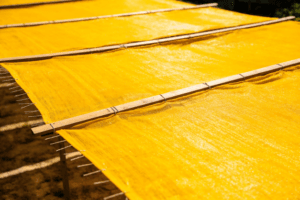
Standard industrial shading isn’t just about blocking light; it is about managing airflow velocity. When wind passes through the micro-pores of a high-density industrial net, its speed is fractured and dissipated. This creates a “dead air” zone on the leeward side of the net, where air velocity is insufficient to carry heavy aggregate particles. By covering stockpiles with custom-fitted Agricultural Shade Net (re-engineered for industrial density), the wind speed over the dust source is reduced by over 80%, forcing particulate matter to remain settled in the pile rather than being carried into the atmosphere.
Custom Engineering: Why Stock Sizes Fail Industrial Loads
Industrial sites are geometrically complex. Stock-sized rolls are built for simple rectangular boundaries and consistently fail in professional settings.
When site managers force stock-sized rolls onto large-span frameworks, they inevitably create “seam junctions” where two rolls meet. These overlaps are the primary point of failure. In high-wind industrial zones, these manual seams lack the tensile strength of the base material and will tear under stress, creating localized turbulence that exacerbates dust dispersion. Custom-sized panels eliminate these seams. By ordering pre-fabricated panels that match the exact footprint of the stockpile or the height of the containment fence, industrial operations ensure a uniform surface that maintains consistent structural tension across the entire containment area.
Aerodynamic Stability: Wind-Load Management
The “sail effect” is the greatest threat to industrial perimeter fencing. If a containment screen is too dense and non-porous, wind pressure will eventually cause the support structure to buckle or uproot from concrete footings.
Custom-sized heavy-duty netting allows industrial engineers to specify the exact porosity required for local wind loads. By combining monofilament warp yarns with specific knitting patterns, our industrial-grade nets maintain a high bursting strength while ensuring the wind-load profile is aerodynamically sound. This precision sizing ensures the net neither flaps (which causes friction-tear) nor creates excessive uplift, maintaining the fence’s structural integrity even during cyclonic gusting.
Lifecycle ROI: UV Stabilization for Extreme Environments
Industrial nets are exposed to 24/7 solar radiation. Without specialized chemical stabilization, the netting will undergo photo-oxidation, turning brittle and shattering within a single season.
Xinhang’s heavy-duty industrial solutions utilize 100% virgin High-Density Polyethylene (HDPE) compounded with high-concentration Hindered Amine Light Stabilizers (HALS). HALS scavenge free radicals generated by solar UV photons, ensuring the netting remains flexible and physically intact for 5 to 10 years. For industrial sites, this longevity is essential; frequent replacement of perimeter containment is not just a material expense, but a significant labor and downtime cost that custom-fabricated, high-stabilization nets effectively eliminate.
Procurement Strategy: Manufacturer-Direct Customization
To secure enterprise-grade reliability, project leads must contract directly with production facilities. Intermediaries often struggle to guarantee the structural finish quality, frequently supplying non-stabilized textiles that fail under professional stress.
As a globally verified Shade Net manufacturer based in Lizhuang, Xinhang offers complete vertical control. We manage the extrusion of 100% virgin HDPE, the precise warp-knitting process, and the custom sewing lines that reinforce your panels with heavy-duty polyester webbing. By sourcing direct, enterprise teams verify material integrity at the source, ensure GSM and HALS compliance, and receive factory-finished panels that provide a robust, long-term barrier against dust and debris transfer.
Industrial Procurement Frequently Asked Questions (FAQ)
Q1: Why do industrial sites prefer “Knitted” over “Woven” netting?
Knitted netting uses an interlocking lockstitch design. If a sharp piece of industrial aggregate punctures a knitted net, the stitch locks in place and prevents the tear from unravelling. Woven nets lack this locking mechanism; a small snag can easily unzip the entire panel, leading to widespread debris containment failure.
Q2: What grommet spacing is recommended for high-wind perimeter fencing?
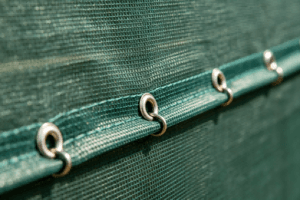
For industrial zones subject to high-speed wind, a 30 cm grommet spacing is recommended over the standard 50 cm. This closer spacing increases the number of attachment points, effectively lowering the tensile stress concentrated on each individual point of the perimeter fence, providing a much higher safety margin against gusting winds.
Q3: How do we handle large panels that exceed container limits?
We fabricate “ready-to-splice” panels with factory-reinforced edges that can be quickly joined on-site using heavy-duty lacing. Because our edges are factory-finished and grommeted, the splicing process remains structurally secure and maintains the tensile load-bearing capacity required for large perimeter barriers.
Q4: Can these panels be customized with specific flame-retardant (FR) requirements?
Yes. We can incorporate FR masterbatches into the virgin HDPE resin during extrusion, ensuring the entire panel meets global fire-safety standards (e.g., NFPA 701) for construction and industrial sites where hot-work (welding/cutting) is prevalent.
Q5: How does factory-finished webbing improve the net’s lifespan?
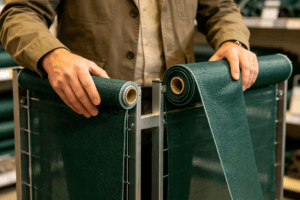
Webbing tape acts as the structural spine for the panel. By securing grommets in the multi-layered polyester webbing, the load is distributed across the entire border rather than just the thin netting filaments. This prevents the fabric from tearing at the mounting points, ensuring the screen remains intact even under intense, long-term wind loading.
References & Technical Standards:
- Fugitive Dust Suppression and Structural Design Guidelines: Shade Cloth Store Industrial Solutions
- Polymer Stabilization and UV Degradation Metrics: Greenhouse Megastore Material Science Specs
- Industrial Wind Load Management and Netting Topography: Farm Plastic Supply Field Implementation