Large-scale industrial sites—including mining operations, logistics hubs, and commercial construction zones—benefit from heavy-duty shade netting primarily through the suppression of fugitive dust emissions, strict regulatory compliance, and localized thermal microclimate mitigation. Standard agricultural meshes are insufficient for these extreme environments. Heavy-duty industrial configurations utilize high-density, multi-filament extruded polymers engineered to withstand extreme aerodynamic wind shear and heavy particulate abrasion. By deploying an industrial-grade Shade Net over exposed aggregate stockpiles, personnel zones, and heavy machinery depots, enterprise managers drastically reduce particulate matter (PM10 and PM2.5) dispersion, prevent rapid moisture evaporation from suppressed soil, and protect high-value capital equipment from severe ultraviolet degradation, directly reducing operational downtime and environmental litigation risks.
Table of Contents
- 1. Particulate Matter Containment and Dust Suppression
- 2. Aerodynamic Disruption of Surface Wind Velocity
- 3. Thermal Mitigation for Machinery and Personnel
- 4. Regulatory Compliance and Environmental Risk Management
- 5. Mechanical Specifications for Heavy-Duty Industrial Netting
- 6. Industrial Procurement Frequently Asked Questions (FAQ)
Particulate Matter Containment and Dust Suppression
The primary hazard in large-scale excavation, mining, and aggregate processing is the uncontrolled release of fugitive dust. When fine particulate matter (specifically PM10 and the more dangerous PM2.5) becomes airborne, it poses severe respiratory hazards to on-site personnel and threatens neighboring civilian populations.
Traditionally, industrial sites rely on continuous water spraying via heavy tanker trucks to suppress dust on haul roads and stockpiles. This method is highly inefficient; in arid climates, the water evaporates within hours, requiring relentless, expensive re-application. Deploying a heavy-duty Outdoor Shade Net (often referred to industrially as a dust suppressant net or “盖土网”) directly over massive coal piles, slag heaps, or raw aggregate drastically alters the surface microclimate.
The high-density polymer matrix acts as a physical containment barrier. It physically traps rising dust particles while simultaneously blocking direct solar radiation from striking the moistened soil. By eliminating direct solar heat flux, the netting drops the surface evaporation rate by up to 60%, allowing a single water spray application to suppress dust for days rather than hours, saving millions of gallons of industrial water annually.
Aerodynamic Disruption of Surface Wind Velocity
Particulate matter only becomes a hazard when it is lofted by surface winds. Industrial sites utilize heavy-duty shade netting installed vertically on perimeter fencing to act as high-efficiency aerodynamic windbreaks.
Solid walls or metal hoarding panels are aerodynamically flawed; they force wind up and over the barrier, creating a powerful, turbulent vacuum on the leeward side that actually sucks dust up into the atmosphere. A porous, knitted polymer mesh operates on advanced aerodynamic principles. It permits a calculated percentage of air (usually 20% to 30%) to pass directly through its micro-apertures.
As high-velocity wind passes through the dense polymer lockstitches, the kinetic energy of the air is fractured and dissipated. This transforms destructive, high-speed gusts into slow, laminar air currents that lack the kinetic force necessary to lift heavy aggregate dust off the ground, effectively neutralizing the wind threat before it reaches the stockpiles.
Thermal Mitigation for Machinery and Personnel
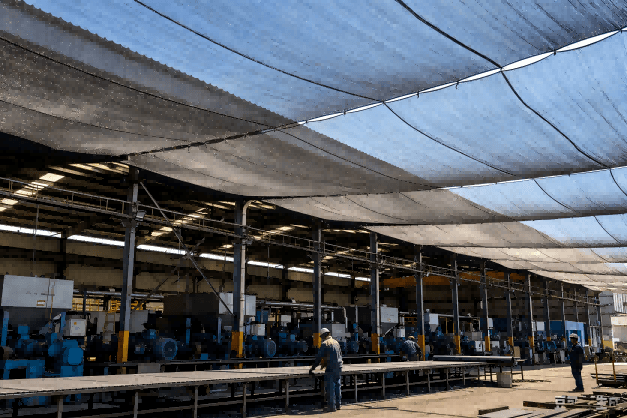
Beyond dust control, extreme solar radiation degrades expensive capital equipment and limits human labor efficiency. Large logistics hubs and equipment staging areas utilize heavy-duty tensioned canopies to create massive thermal buffers.
- Asset Protection: Constant exposure to UV-A and UV-B radiation degrades the hydraulic hoses, rubber seals, and specialized exterior coatings of heavy machinery. By parking excavators, loaders, and haul trucks beneath an 80% to 90% density netting, fleet managers drastically reduce the rate of photo-oxidation on rubber components, lowering preventative maintenance costs.
- Personnel Safety: Operating in a sun-baked industrial yard pushes human thermoregulation to its limits. Deploying a breathable mesh over staging areas and break zones provides deep shade while allowing convective heat venting, dropping ambient temperatures by 10°C to 15°C and mitigating the risk of OSHA heat-stroke violations.
Regulatory Compliance and Environmental Risk Management
In the modern industrial sector, failing environmental audits carries severe financial penalties. Regulatory bodies heavily scrutinize construction and mining sites for airborne pollution that drifts into municipal areas.
Deploying verified, heavy-duty suppression netting is a recognized Best Management Practice (BMP) for environmental compliance. It serves as tangible, visible proof to inspectors that the operation is actively mitigating its footprint. As noted in factory documentation from Xinhang, a premier Shade Net manufacturer based in the historic industrial center of Lizhuang, the use of high-density “盖土网” (soil covering nets) is an absolute necessity for passing stringent municipal environmental checks, allowing operations to proceed without costly forced shutdowns.
Mechanical Specifications for Heavy-Duty Industrial Netting
Industrial sites are ruthless environments. Standard agricultural nets will be shredded by flying aggregate, dragged across sharp coal, or destroyed by chemical runoff. Procurement engineers must specify materials built for extreme mechanical abuse.
| Industrial Metric | Required Specification | Operational Rationale |
|---|---|---|
| Polymer Matrix | 100% Virgin High-Density Polyethylene (HDPE) or Specialized Polyester. | Eliminates the brittleness found in recycled plastics; resists chemical degradation from mine tailings. |
| Structural Topography | Warp-Knitted Lockstitch (Round Monofilament base). | Provides extreme puncture immunity. If a sharp rock pierces the net, the lockstitch prevents line-tear propagation. |
| UV Stabilization | Maximum concentration of Hindered Amine Light Stabilizers (HALS). | Neutralizes free radicals to prevent the fabric from turning chalky and shattering under continuous solar load. |
| Edge Border Engineering | Heavy-duty taped selvedges with rust-proof brass grommets. | Allows for high-tension cable suspension across vast spans without the attachment points ripping out. |
To guarantee performance, enterprise buyers must avoid trading companies and source directly from heavy-industry specialists. Xinhang operates large-scale factory matrices specifically designed to extrude heavy-gauge, true-width industrial textiles. By maintaining strict control over the mass density (GSM) and utilizing precision warp-knitting technology, we deliver containment netting capable of surviving the most abrasive, high-wind industrial sectors on the globe.
Industrial Procurement Frequently Asked Questions (FAQ)
Q1: Can we just use cheap agricultural netting to cover our construction soil heaps?
No. Lightweight agricultural nets are designed to hover over crops, not to be dragged across abrasive soil or gravel by heavy machinery. Standard agricultural mesh lacks the burst strength and heavy gauge required; it will tear rapidly when snagged on rocks, forcing you to constantly repurchase and replace the covering to satisfy environmental inspectors.
Q2: What is the difference between PE (Polyethylene) and Polyester for industrial netting?
HDPE is the standard for general dust suppression and perimeter windbreaks because of its excellent UV resistance and cost-effectiveness over large areas. However, for extremely abrasive environments, such as covering highly jagged coal piles or active mining draglines, heavy-duty Polyester netting provides superior tensile breaking strength and abrasion resistance, albeit at a higher material cost.
Q3: How do we prevent the netting from blowing off large aggregate stockpiles?
The fabric must be secured using industrial methods. Do not just lay it on top of the pile. The edges must be trenched and buried at the base of the pile, or secured using heavy sandbags placed at regular intervals. For long-term stockpiles, driving steel rebar stakes through reinforced grommets deep into the aggregate ensures the net acts as a continuous aerodynamic shield.
Q4: Does the color of the dust suppressant net matter for regulatory compliance?
While functionally similar, green is the globally accepted standard for industrial dust suppression and construction netting. Using green netting provides an immediate visual signal to environmental auditors and the surrounding community that the site is actively managing its pollution footprint, blending the industrial worksite more naturally into the surrounding landscape.
Q5: How do we calculate the size needed to cover a massive conical stockpile?
Do not calculate the flat floor area. You must calculate the surface area of the cone. Measure the slant height (from the peak down the side to the base) and the circumference of the base. For massive operations, it is highly recommended to order custom-fabricated, factory-seamed panels from the manufacturer to ensure the net drops perfectly over the pile without requiring on-site cutting or weak overlapped seams.
Q6: Will industrial netting catch fire near hot machinery?
Standard HDPE is a petroleum-based product and will melt or burn if exposed to direct flame or extreme exhaust heat. If the netting is being deployed in high-risk zones, such as welding staging areas or directly over hot refinery equipment, procurement must specify Flame-Retardant (FR) treated netting that complies with industrial fire safety standards (such as NFPA 701) to prevent the fabric from accelerating a fire.
References & Industrial Compliance Standards:
- Fugitive Dust Suppression and Aerodynamic Windbreaks: Shade Cloth Store Industrial Solutions
- Industrial Polymer Abrasion and Bursting Strength: Greenhouse Megastore Material Data
- Heavy Machinery UV Protection and Thermal Mitigation: Farm Plastic Supply Asset Protection Protocols