To measure a structure for a custom-sized Shade Net fitting, procurement teams must translate three-dimensional architectural volumes into precise, two-dimensional fabrication specifications that incorporate tensile elongation allowances and factory-finished edge requirements. Generic measurements based on floor area consistently result in catastrophic material shortages, improper canopy tension, and accelerated fabric failure due to aerodynamic flutter. A successful measurement protocol requires defining the exact mounting points, calculating the true arc length of the structural frame, and applying a calculated negative tension allowance to ensure the warp-knitted HDPE mesh maintains a drum-tight, weather-resistant fit. By providing a CAD-ready measurement package to a professional Shade Net manufacturer, buyers eliminate on-site cutting waste and guarantee a precise, high-performance environmental shield.
Table of Contents
The Geometry of Canopy Footprints
The most common error in procurement is equating the footprint of the ground area with the required fabric dimension. An Agricultural Shade Net must follow the structural contours of the frame, which frequently involves significant vertical elevation.
For gable-roof or A-frame structures, the netting must travel from the gutter, up the rafter to the ridge, and back down to the opposite gutter. Using the Pythagorean theorem ($sqrt{text{Rise}^2 + text{Run}^2} = text{Slope Length}$) is mandatory. A structure with a 5-meter horizontal run and a 3-meter ridge height requires a slope length of approximately 5.83 meters per side. Ordering based on floor width ignores the height entirely, leading to a canopy that cannot reach the ridge pole or is too short to cover the crop area.
Calculating Arc Lengths for Arch Structures
Hoop houses and Quonset structures require precision arc length measurements. The fabric must be long enough to stretch over the curve of the steel arch, not just the ground diameter.
For a perfect semi-circular hoop, the required fabric width is determined by half the circumference of the circle: $frac{1}{2} times pi times text{Diameter}$. If the ground diameter is 10 meters, the net must be at least 15.7 meters wide to cover the arch.
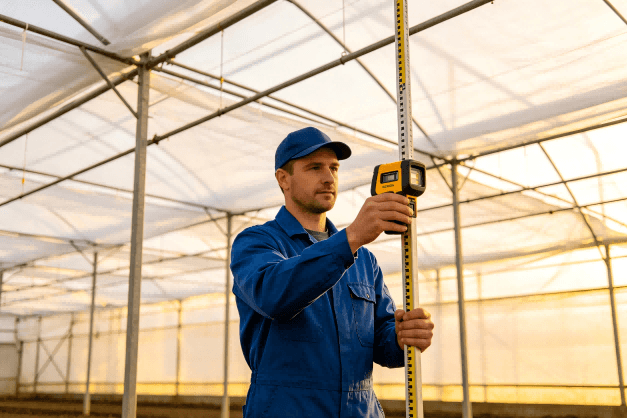
In commercial practice, arches are often “Gothic” style—possessing straight side-walls. In this scenario, measure the straight wall height, add it to the calculated arc length of the curved roof section, and repeat for the opposite side. It is standard practice to use a flexible measuring tape to drape directly over the hoop assembly to account for the physical thickness of the steel pipe, as these small variances accumulate over massive multi-span installations.
Tension Allowances for Warp-Knitted HDPE
A high-performance Outdoor Shade Net features a warp-knitted lockstitch matrix. This structure provides essential multidirectional elasticity, which allows the canopy to absorb wind shocks. However, it also means the fabric has a “tension stretch.”
If a buyer orders the exact structural dimension without a negative tension allowance, the net will arrive slightly too large. Once installed, it will sag, flutter in the wind, and eventually tear from friction.
Commercial engineers apply a 1.5% to 3% negative allowance. If the structural span is 50 meters, the fabric panel is fabricated to 48.5 meters. The installation team then uses mechanical tensioning hardware (turnbuckles or wiggle wire) to stretch that 48.5-meter panel across the 50-meter span. This results in a drum-tight canopy that is aerodynamically stable and perfectly prepared to handle structural wind loads.
Accounting for Edge Reinforcement and Hardware
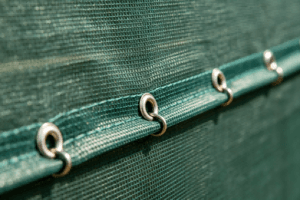
The edges of a custom panel are not just “finishings”—they are structural components. An industrial-grade panel must have heavy-duty, multi-layered polyester webbing tape sewn along all borders.
When calculating dimensions, buyers must factor in the width of this webbing. If the interior greenhouse frame is exactly 10 meters, and you require a webbing overlap for attachment, the panel might need to be 10.1 meters wide. Furthermore, if you are using brass grommets for attachment, ensure they are placed within the webbing. A grommet punched through a single layer of raw mesh is a guaranteed failure point; it will rip through the filaments under the first sign of pressure. The webbing must be wide enough to accept the grommet hole while leaving sufficient structural material to handle the pulling force of the bungee or steel tie.
Procurement Checklist for Factory-Finished Panels
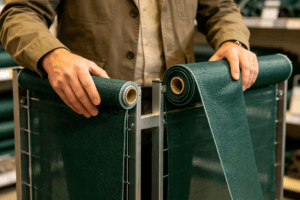
Eliminate on-site labor waste by mandating a complete, factory-fabricated panel specification.
| Measurement Parameter | Requirement Definition | Why It Matters |
|---|---|---|
| Structural Arc/Slope Length | True contour length of the frame. | Prevents fabric shortfall at ridge peaks. |
| Negative Tension Allowance | 1.5% – 3% deduction from span length. | Ensures drum-tight, flutter-free canopy fit. |
| Edge Webbing Width | 5cm – 8cm reinforced polyester tape. | Transfers tension load away from mesh. |
| Grommet Spacing | 50cm (Industry standard spacing). | Prevents localized sagging between fasteners. |
| Seam Joinery (if multi-panel) | 5cm factory-sewn double lockstitch overlap. | Optimizes material usage; avoids bulk seam waste. |
Frequently Asked Questions (FAQ) on Measurement
Q1: Why can’t I just order the ground footprint and cut the excess on-site?
Cutting netting on-site is a critical error. Once the factory-sealed, heavy-duty selvedge border is cut, the raw edge is immediately susceptible to unravelling and tear propagation. You lose the structural strength provided by the factory webbing, and the exposed yarn ends become weak points that will fail in the next windstorm.
Q2: What is the risk of ordering “True-Width” dimensions without verifying heat shrinkage?
If you don’t account for heat shrinkage (thermal memory), the polymer will reset when exposed to the desert sun, causing the panel to shrink. If the panel shrinks even by 2%, it can rip the grommets directly out of the support cables. Always ask your manufacturer if the fabric is “heat-set” for dimensional stability.
Q3: How do I handle measurement variance on very long structural spans?
When spans exceed 30 meters, measurement variance is inevitable. It is safer to order the net in modular factory-finished panels that align with your support column spacing. This allows you to tension each panel individually, managing the cumulative expansion and contraction without overstressing a single, massive, 100-meter-long piece of fabric.
References & Technical Standards:
- CAD Modeling and Structural Specification Protocols: Shade Cloth Store Fabrication Guidelines
- ASTM Polymer Tensile Elongation and Stability Metrics: Greenhouse Megastore Technical Standards
- Warp-Knitted Mesh Tensioning and Aerodynamic Modeling: Farm Plastic Supply Field Implementation