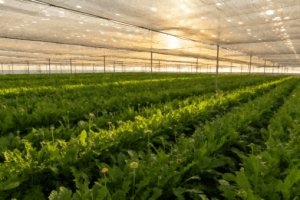
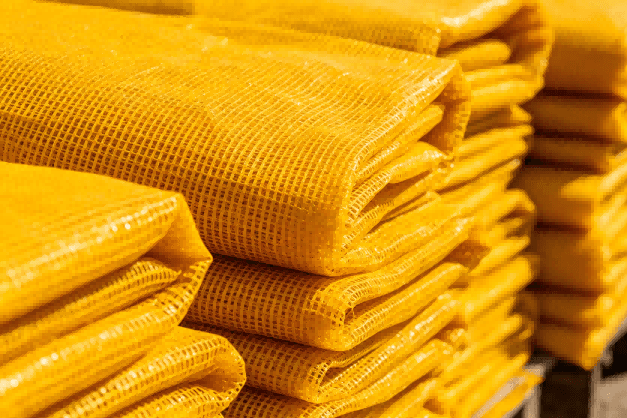
When evaluating protective agricultural and industrial textiles for high-wind environments, lockstitch knitted mesh is structurally superior to traditional woven alternatives. The primary advantage lies in the textile’s mechanical response to severe aerodynamic drag. Knitted configurations possess inherent multidirectional elasticity, allowing the fabric to stretch and dissipate the kinetic energy of violent wind gusts rather than transferring sudden, rigid force directly to structural anchors. Furthermore, the interlocking loop design prevents line-tear propagation; if a flying debris punctures the material, the lockstitch confines the damage to the immediate impact zone, whereas woven materials will rapidly unravel. For commercial growers and facility managers, selecting the correctly engineered Shade Net prevents catastrophic canopy failures and secures long-term infrastructure ROI.
Table of Contents
Aerodynamic Forces and Structural Microclimates
Industrial protection structures operate within volatile aerodynamic microclimates. The interaction between high-velocity ambient wind and a suspended textile grid generates specific mechanical loads that dictate the survival of the canopy. When deploying an Outdoor Shade Net over expansive acreage, project managers must account for both positive windward pressure and leeward vacuum forces.
Solid films or unperforated sheets act as total aerodynamic barriers. They block airflow entirely, creating a severe sail effect that transfers immense dynamic stress onto galvanized steel frames, tension cables, and ground anchors. A properly engineered porous mesh mitigates this by allowing a controlled volume of air to pass through its structural apertures. As the wind penetrates the fabric, the dense polymer filament matrix fractures the large, high-velocity air streams into gentle, low-speed convective currents.
However, the continuous passing of air places extreme mechanical shear stress on the individual yarns. Under sustained wind loads, inferior fabrics begin to vibrate at high frequencies—a phenomenon known as flutter. This high-speed mechanical whipping generates localized friction at the attachment points. If the textile lacks sufficient elasticity to buffer this kinetic energy, the friction will snap the filaments, leading to rapid structural collapse.
Mechanical Engineering: Knitted vs. Woven Topography
The precise interlacing technology utilized during the manufacturing process establishes how the fabric behaves under violent dynamic loads. The physical topography of the material is the primary differentiator between successful wind resistance and catastrophic field failure.
Woven Fabric Configurations
Woven protective textiles are produced by interlacing two distinct sets of parallel yarns—the warp and the weft—at fixed, perpendicular 90-degree angles. This traditional methodology creates a highly dense, uniform grid that delivers exact shading percentages and minimal light scattering. Due to its rigid interlocking nature, a woven canopy exhibits minimal tensile elongation along its primary axes.
This lack of flexibility becomes a fatal flaw in high-wind regions. When subjected to a severe storm gust, the rigid woven fabric cannot stretch to absorb the shock. Instead, 100% of the dynamic force is instantly transmitted to the fasteners, eyelets, and support cables, frequently resulting in ripped anchoring points. Furthermore, if a single warp or weft strand is severed by flying debris, the perpendicular yarns lose their anchor and immediately slide apart. This creates a chain reaction of unweaving that destroys the entire panel.
Lockstitch Knitted Configurations
Conversely, modern industrial facilities manufacture Agricultural Shade Net using advanced warp-knitting machinery. This process forms continuous rows of interlocking polymer loops rather than rigid perpendicular grids. The lockstitch geometry provides exceptional puncture immunity. If a branch or hailstone penetrates the fabric, the interlocking loops lock the broken thread in place, preventing the damage from propagating across the panel.
More importantly, the looped architecture provides inherent multidirectional elasticity. When a sudden wind gust hits a knitted canopy, the loops flex and deform slightly, momentarily expanding the micro-apertures. This expansion lets excess air pass through rapidly while the fabric stretches, absorbing and dissipating the kinetic shockwave before it reaches the structural support poles.
Comparative Performance Analysis Data
To accurately source commercial textiles, agronomists and procurement engineers rely on standardized mechanical testing metrics. The following table contrasts the baseline performance of woven versus lockstitch knitted configurations under extreme environmental stressors.
| Technical Parameter | Woven Netting Matrix | Knitted Netting Matrix |
|---|---|---|
| Dynamic Tear Propagation | High. Unravels rapidly if cut. | Zero. Lockstitch halts run formation. |
| Kinetic Energy Absorption (Elasticity) | Low (Rigid grid transfers stress). | High (Loops expand to absorb wind shock). |
| Tensile Strength Loading (ASTM D5034) | High linear strength, low diagonal strength. | Uniform multidirectional tensile capacity. |
| Suitability for Retractable Systems | Poor. Prone to edge fraying on tracks. | Excellent. Resists friction and mechanical rolling. |
| Optimal Commercial Application | Interior greenhouse shades, ground covers. | High-wind open fields, hail protection, multi-span roofs. |
Extrusion Geometry: Tape vs. Round Monofilament
Beyond the interlocking methodology, the cross-sectional shape of the extruded high-density polyethylene (HDPE) yarn significantly influences the material’s aerodynamic drag coefficient.
- Flat Tape (Ribbon) Filaments: Tape yarns maximize polymer surface area, offering exceptional light-blocking efficiency and thermal insulation at a lower material weight. However, their flat profile acts as a micro-sail. Under high wind velocities, flat tape geometries catch maximum air resistance, increasing the lateral mechanical load on support frames. They are highly efficient for low-wind environments or interior shading.
- Round Monofilament Filaments: Extruded as solid, cylindrical lines, round monofilaments possess supreme hydraulic bursting strength. The cylindrical shape slices through air currents with minimal resistance, drastically lowering the drag coefficient of the overall panel. For locations subject to typhoons, coastal winds, or heavy hail, a 100% round monofilament lockstitch knit is the absolute industry standard.
- Hybrid Tape & Monofilament: Advanced manufacturers frequently weave round warp yarns for longitudinal structural strength with flat tape weft yarns to achieve specific shading densities, offering a balanced compromise between wind resistance and light reduction.
Commercial Procurement and Quality Validation
Sourcing reliable wind-resistant canopies demands strict technical validation from the primary production source. Based in Lizhuang, the historical center of China’s rope and netting industry, Xinhang operates as a premier Shade Net manufacturer with full control over the extrusion and weaving processes.
To survive extreme environmental stresses, the fabric must be extruded from 100% Virgin HDPE base resin. Recycled polymer blends introduce chemical impurities that weaken the molecular bonds, leading to catastrophic brittleness under sustained UV exposure. Furthermore, industrial-grade textiles must be compounded with Hindered Amine Light Stabilizers (HALS). These chemical agents actively scavenge the free radicals generated by photo-oxidation, preserving the tensile elasticity of the netting for 5 to 7 years in severe climates.
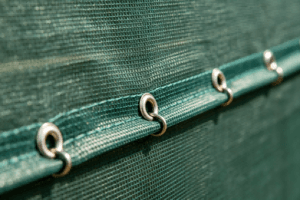
Finally, enterprise buyers must require heavy-duty edge selvedge reinforcement. Raw-cut edges will immediately fray in high winds. Xinhang integrates multi-layered polyester web taping and high-density lockstitch borders, outfitted with rust-proof brass eyelets, to guarantee that mechanical tension is safely distributed across the entire support infrastructure.
Frequently Asked Questions (FAQ)
Q1: Why does woven netting unravel easily compared to knitted netting?
Woven netting utilizes a perpendicular warp-and-weft design held together purely by friction. If a single strand is cut or broken by flying debris, the surrounding strands lose their tension and quickly slide apart under wind pressure. Knitted netting uses interlocking loops; if one loop breaks, the surrounding lockstitches isolate the damage, preventing the tear from propagating across the panel.
Q2: What is the ideal filament geometry for a highly exposed, windy coastal farm?
For extreme high-wind zones, a 100% round monofilament lockstitch knitted net is required. Round filaments possess the lowest aerodynamic drag, allowing wind to slip through the fabric without creating excessive lateral force on the support poles, while maintaining maximum bursting strength against hail and coastal storms.
Q3: How does tension impact the wind resistance of a knitted canopy?
Proper installation tension is critical. While knitted nets are elastic, if they are installed too loosely, they will suffer from wind flutter—rapid, violent shaking that causes friction wear against the steel frame and cables. The net must be tensioned firmly to distribute kinetic energy evenly across the entire grid without localized chafing.
Q4: Are flat tape shade nets suitable for outdoor structural use?
Flat tape nets are economical and provide excellent shading, but they act like small sails and catch high amounts of wind. They are generally recommended for low-wind environments, interior greenhouse thermal screens, or smaller structural spans where severe aerodynamic drag will not compromise the anchors.
Q5: What laboratory tests confirm a fabric’s ability to withstand high winds?
Procurement teams should verify mechanical limits via two primary tests: ASTM D5034 (Grab Test), which measures the linear tensile breaking strength, and ASTM D3786 (Mullen Burst Test), which assesses the hydraulic bursting strength to ensure the fabric can withstand perpendicular blunt force impacts like severe wind shear or hail.
References & Industry Standards:
- Polymer Extrusion and Textile Analysis: Greenpro Ventures Knitted vs Woven Documentation
- ASTM Material Mechanical Performance Thresholds: Greenhouse Megastore Shade Materials Guide
- Agricultural Wind Mitigation Strategies: Farm Plastic Supply Technical Frameworks