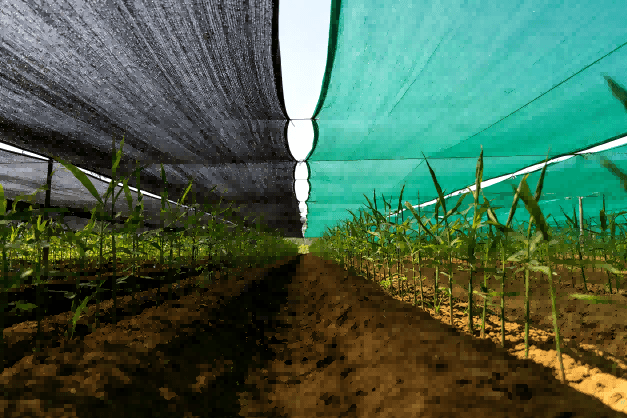
The choice between black and green shade netting directly determines commercial crop yield by fundamentally altering the radiometric properties of the agricultural microclimate. Black netting functions as a broadband radiometric filter, absorbing solar energy across all wavelengths to provide highly stable, non-selective thermal buffering. In contrast, green netting operates as a photo-selective radiometric filter. By absorbing specific red and blue wavelengths while transmitting green and far-red light, green fabrics manipulate the Red to Far-Red (R:FR) ratio within the canopy. This spectral shift simulates a natural understory environment, triggering specific physiological responses such as increased leaf surface area and stem elongation. For enterprise agronomists, selecting the correct Shade Net color requires matching these radiometric behaviors to the specific morphological targets of the crop—utilizing black for maximum thermal reduction and green for optimized vegetative expansion.
Table of Contents
- 1. The Physics of Photo-Selective Shading and Plant Morphology
- 2. Black Shade Netting: Broadband Absorption and Thermal Dynamics
- 3. Green Shade Netting: Spectral Modification and Yield Enhancement
- 4. Quantitative Data: Yield and Microclimate Comparison Matrix
- 5. Commercial Procurement: Integrating Pigments with HDPE Matrices
- 6. Frequently Asked Questions (FAQ)
The Physics of Photo-Selective Shading and Plant Morphology
To accurately assess how canopy color impacts yield, one must differentiate between the quantity of light and the quality of light. Traditional agricultural shielding primarily addressed light quantity by reducing the total volume of Photosynthetically Active Radiation (PAR) reaching the crop floor to prevent thermal stress and chlorophyll bleaching.
However, plant photoreceptors—specifically phytochromes and cryptochromes—do not merely measure light volume; they analyze the spectral composition of the light to regulate growth. Photo-selective netting is engineered to manipulate this spectral composition. By utilizing specific polymer masterbatches during the extrusion process, manufacturers can dictate exactly which nanometer wavelengths are absorbed, reflected, or transmitted through the mesh.
This manipulation directly impacts the canopy microclimate and the plant’s internal hormonal balance. When a colored mesh alters the ratio of blue light (400–500 nm) to red light (600–700 nm), or the Red to Far-Red (R:FR) ratio, it triggers specific photomorphogenic responses. These responses dictate whether the plant expends its carbohydrate reserves on vegetative expansion (leaf size and stem length) or reproductive development (flower and fruit set). Consequently, deploying an Agricultural Shade Net is no longer just about cooling the greenhouse; it is an active agronomic tool for directing plant architecture and maximizing target yields.
Black Shade Netting: Broadband Absorption and Thermal Dynamics
Black agricultural fabrics are manufactured using highly concentrated carbon black additives. Carbon black is the most efficient UV and visible light absorber available in polymer science.
Radiometric Behavior of Black Filaments
A black net is non-selective; it acts as a neutral density filter. It absorbs solar radiation evenly across the ultraviolet, visible PAR, and near-infrared (NIR) spectra. Because it does not selectively filter specific colors, the light that passes through the micro-apertures of the lockstitch remains spectrally identical to natural sunlight, simply reduced in overall intensity. This guarantees that the plant receives a balanced light spectrum, preventing unnatural morphological stretching.
Thermal Buffering Capabilities
Because black filaments absorb massive amounts of solar energy, they convert that light into sensible heat. The physical netting itself becomes warm. In open-field applications or high-tunnel structures with excellent convective ventilation, this heat is rapidly carried away by ambient wind, resulting in a drastically cooled environment beneath the canopy.
However, if deployed as an internal greenhouse screen without proper overhead venting, the heated black fabric will radiate long-wave thermal energy downward, potentially raising the stomatal conductance stress of the upper crop layer.
Optimal Yield Applications for Black Netting:
- High-Radiation Deserts: Provides the most robust, long-lasting UV barrier for extreme climates.
- Livestock & Poultry Enclosures: Excellent for purely thermal reduction where plant photomorphogenesis is irrelevant.
- Orchard Sunscald Protection: Neutral shading prevents fruit skin burning without altering the natural ripening hormones of the tree.
Green Shade Netting: Spectral Modification and Yield Enhancement
Green agricultural nets are extruded with specialized pigments designed to actively filter the solar spectrum. Unlike black nets, green nets interact selectively with specific nanometer wavebands, primarily transmitting green light (500–600 nm) while heavily absorbing red and blue light.
Simulating the Understory Microclimate
In nature, light that reaches the forest floor has already passed through the upper canopy leaves. Those upper leaves absorb most of the red and blue light for photosynthesis, allowing primarily green and far-red light to reach the plants below. Deploying a green Outdoor Shade Net artificially recreates this specific understory light signature.
Physiological Response: Vegetative Expansion
When plants sense this spectral shift—specifically the lowered Red to Far-Red ratio—their phytochromes signal a “shade avoidance” response. To capture more light, the plant reallocates its biomass energy away from immediate root thickening and instead drives vegetative expansion. This results in:
- Increased Leaf Area Index (LAI): Leaves grow wider and broader to maximize photon capture.
- Internode Elongation: Stems stretch upward, which is highly desirable for the cut-flower industry.
- Higher Chlorophyll Density: The plant increases chlorophyll production per square centimeter, resulting in deeper, richer foliage colors.
Optimal Yield Applications for Green Netting:
- Leafy Greens and Herbs: Radically increases the harvestable biomass of lettuce, spinach, basil, and microgreens by forcing leaf expansion.
- Foliage Nurseries: Deepens the visual green pigmentation of ornamental plants, raising their retail market value.
- Floriculture (Cut Flowers): Promotes long, straight stems and larger calyx development prior to blooming.
Quantitative Data: Yield and Microclimate Comparison Matrix
The following matrix outlines the standardized impacts of 50% density black and green shading on commercial microclimates and specific crop profiles.
| Agronomic Metric | Black Shade Netting (50%) | Green Shade Netting (50%) |
|---|---|---|
| Spectral Filtration Profile | Neutral density filter. Lowers all wavelengths equally. R:FR ratio unchanged. | Photo-selective. Absorbs Red/Blue. Lowers the R:FR ratio significantly. |
| Thermal Management | High energy absorption. Can become warm; requires good wind ventilation. | Moderate absorption. Reflects some visible light, keeping filaments cooler. |
| Morphological Crop Impact | Standardized growth. Prevents thermal dwarfing but does not force leaf expansion. | Triggers shade-avoidance. Promotes rapid leaf expansion and internode elongation. |
| Optimal Commercial Crop Types | Tomatoes, Peppers, Orchards, Livestock. | Lettuce, Spinach, Foliage Ornamentals, Cut Flowers. |
| Polymer UV Longevity | Maximum. Carbon black naturally scavenges UV radicals. 7+ years lifespan. | High. Requires strict addition of HALS stabilizers for 5+ years lifespan. |
Commercial Procurement: Integrating Pigments with HDPE Matrices
Sourcing photo-selective netting requires a verified manufacturing partner capable of precise masterbatch compounding. Inferior trading companies frequently sell standard green-dyed plastics that lose their spectral properties within months of UV exposure, resulting in unpredictable crop yields as the pigment fades.
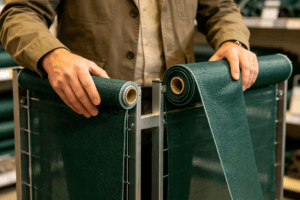
As an established Shade Net manufacturer located in Lizhuang, Xinhang engineers both black and green commercial textiles utilizing strictly 100% virgin High-Density Polyethylene (HDPE). Our extrusion process binds the color pigments directly into the polymer matrix at the molecular level, supported by advanced Hindered Amine Light Stabilizers (HALS). This prevents photo-oxidation and ensures that a Xinhang green net will deliver the exact same understory spectral signature in year five as it did on the day of installation.
Enterprise buyers must mandate verified mass density parameters (GSM) alongside color specifications. A black net stretched too thin loses its thermal buffering capability, while a thin green net allows excessive direct light to pierce the canopy, neutralizing the photomorphogenic benefits. Xinhang guarantees strict GSM compliance and true-width dimensions, delivering agricultural infrastructure that maximizes biomass yield and secures long-term ROI.
Frequently Asked Questions (FAQ)
Q1: Will a green shade net increase the yield of fruit-bearing crops like tomatoes or peppers?
Generally, no. Green nets shift the plant’s energy toward vegetative growth (leaves and stems). For fruit-bearing crops like tomatoes and peppers (Solanaceae), excessive vegetative growth can lead to delayed flowering and smaller fruit sets. For these crops, neutral black, white, or specialized red photo-selective nets are far more effective for maximizing fruit biomass.
Q2: Why does a black shade net sometimes cause heat stress in low-clearance tunnels?
Black filaments absorb all solar radiation and convert it into sensible heat. If the net is installed too close to the plant canopy in a tunnel with poor ventilation, the hot fabric radiates long-wave infrared energy downward. To prevent this, black nets must be installed with sufficient overhead clearance and adequate side-wall venting to allow convective air currents to remove the heat.
Q3: How does the Red to Far-Red (R:FR) ratio specifically affect leafy greens?
In full sunlight, the R:FR ratio is high, keeping plants compact. When a green net lowers the R:FR ratio, the plant’s phytochromes interpret this as being shaded by taller competitor plants. The physiological response is “shade avoidance,” prompting the plant to rapidly expand its leaf surface area to capture more light, which drastically increases the harvestable weight of crops like lettuce and spinach.
Q4: Does the color of the net affect its physical tear resistance or wind durability?
No, the physical durability is determined entirely by the polymer type (virgin HDPE) and the manufacturing topography (e.g., lockstitch knitting). Both black and green nets woven with the same GSM and knit pattern will offer identical mechanical resistance against wind and hail impacts.
Q5: How can buyers verify that a green net uses stable pigments that will not fade?
Enterprise buyers should request QUV accelerated weathering test data from the manufacturer. These lab tests simulate years of UV exposure. A true manufacturer will compound the color pigment directly into the virgin HDPE masterbatch along with HALS additives, rather than using surface dyes, ensuring the spectral filtration properties remain stable for years.
References & Technical Agronomy Standards:
- Photo-Selective Netting and Photomorphogenesis: Greenpro Ventures Spectrum Analysis
- Canopy Microclimate Radiometric Evaluation: Farm Plastic Supply Technical Frameworks
- Polymer Pigmentation and UV Stabilization Protocols: Greenhouse Megastore Material Science Guidelines