The fundamental difference between Polyester (PET) and High-Density Polyethylene (HDPE) shade nets for construction protection lies in their macromolecular density and tensile load capacity. HDPE provides an exceptionally lightweight, hydrophobic, and highly UV-stabilized matrix perfect for vertical scaffolding enclosures, debris containment, and perimeter dust suppression. Conversely, Polyester delivers massive linear breaking strength and material weight, making it the strict international standard for horizontal fall protection and heavy-duty structural safety nets. For commercial project managers and safety engineers, selecting the correct Shade Net polymer dictates site compliance, workforce safety, and the ability of the infrastructure to absorb catastrophic kinetic energy during high-altitude construction accidents.
Table of Contents
- 1. Polymer Science: The Structural Mechanics of Safety Netting
- 2. High-Density Polyethylene (HDPE): Debris and Dust Containment
- 3. Polyester (PET): Horizontal Fall Protection Systems
- 4. Fire Retardancy and Chemical Resistance in Industrial Zones
- 5. Mechanical Properties Comparison Matrix
- 6. Enterprise Procurement and Factory Quality Control
- 7. Construction Netting Frequently Asked Questions (FAQ)
Polymer Science: The Structural Mechanics of Safety Netting
Commercial construction environments expose protective textiles to extreme mechanical and environmental stressors. Safety nets must withstand severe aerodynamic wind shear, abrasive concrete dust, intense solar radiation, and sudden blunt-force impacts. The survival of the netting system depends entirely on the molecular architecture of the base resin chosen during the extrusion process.
Polyester (Polyethylene Terephthalate, or PET) is a heavy, dense polymer featuring strong intermolecular forces. Its molecular chains align tightly during manufacturing, resulting in a textile that possesses extraordinary tensile elongation resistance and high burst strength. It is heavy, substantial to the touch, and designed to bear massive localized loads without snapping.
High-Density Polyethylene (HDPE), conversely, is characterized by long, linear hydrocarbon chains that provide extreme flexibility, low density, and a highly hydrophobic matrix. While HDPE does not possess the absolute raw stopping power of Polyester for heavy human falls, it excels in large-scale area coverage. By utilizing precision lockstitch knitting, HDPE can be manufactured into vast, lightweight panels that efficiently break up wind currents and capture particulate matter without overloading the structural scaffolding.
High-Density Polyethylene (HDPE): Debris and Dust Containment
HDPE is the undisputed global standard for vertical scaffolding enclosures and perimeter environmental barriers. While frequently utilized as a premium Agricultural Shade Net, industrial-grade HDPE is extruded with significantly higher mass density (GSM) and robust photo-oxidation stabilizers for the construction sector.
Vertical Scaffolding and Debris Netting
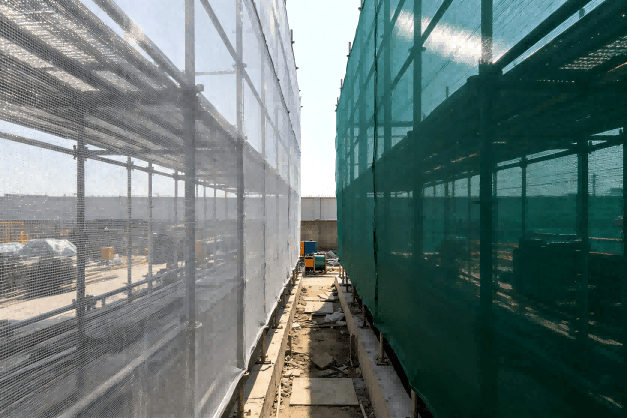
When draping the exterior of a high-rise construction project, weight is a critical engineering constraint. HDPE is extremely lightweight. When manufactured using a warp-knitted lockstitch pattern, it creates a flexible micro-mesh that wraps securely around scaffolding. This netting prevents dropped tools, loose masonry, and stray hardware from ricocheting off the structure and striking pedestrians below. Because it is highly porous, HDPE allows 20% to 30% of ambient air to pass through, reducing the wind load profile on the temporary scaffolding frame and preventing structural tipping during storms.
Fugitive Dust Suppression
In excavation and mining zones, EPA and municipal regulations mandate strict control of particulate matter (PM10). High-density HDPE dust nets (often colored green for environmental compliance) are draped directly over exposed soil heaps and raw aggregate stockpiles. The HDPE matrix physically traps rising dust while simultaneously acting as an Outdoor Shade Net, blocking solar heat flux from drying out the moisture in the soil. Furthermore, its hydrophobic nature ensures that the netting does not absorb water and rot when subjected to continuous dust-suppression sprinkler systems.
Polyester (PET): Horizontal Fall Protection Systems
While HDPE manages the perimeter, Polyester governs internal structural safety. When personnel are operating on open steel frameworks, elevator shafts, or elevated roof trusses, the risk of a high-altitude fall requires a textile capable of extreme kinetic energy dissipation.
National Standard Horizontal Safety Nets
Polyester is the primary material used for heavy-duty horizontal safety nets (often referred to as “National Standard” or “国标” nets in Asian manufacturing hubs). These nets feature large mesh apertures (typically 8cm to 10cm) and thick, multi-strand braided ropes. Polyester is highly valued for this application because it carries substantial physical weight and exhibits virtually no unwanted elasticity.
When a worker falls into a horizontal net, a highly elastic material (like standard nylon or light HDPE) would stretch too far, potentially allowing the worker to strike the concrete floor or lower steel beams before the net arrests the fall. Polyester’s high tensile rigidity ensures the net catches the worker immediately, distributing the shock load across the perimeter anchoring points without excessive central sagging. Furthermore, Polyester is exceptionally resistant to solar UV degradation, ensuring the safety net retains its load-bearing integrity even after months of exposure under a large steel structure.
Fire Retardancy and Chemical Resistance in Industrial Zones
Construction sites are high-risk fire zones due to active welding, grinding sparks, and temporary electrical setups. Both HDPE and Polyester must be rigorously evaluated for fire safety and chemical resistance.
- Fire Retardancy (FR): Standard HDPE will melt and burn if exposed to a direct flame. For high-rise scaffolding applications, municipal fire codes (such as NFPA 701) strictly mandate the use of FR-treated HDPE. During extrusion, halogenated or phosphorus-based flame retardants are mixed into the polymer. If a welding spark hits an FR-treated HDPE net, the material will locally melt but self-extinguish, preventing the fire from climbing the exterior of the building. Polyester possesses a naturally higher melting point than standard HDPE, but horizontal safety nets must also undergo specialized FR treatments to ensure falling slag does not compromise the structural ropes.
- Chemical Inertness: HDPE is highly prized for its chemical inertness. It resists degradation from wet concrete, lime, solvents, and acidic industrial runoff. Polyester is highly resistant to weak acids and standard organic solvents but can degrade if exposed to highly concentrated alkaline solutions over long periods. Therefore, for foundation work involving heavy wet concrete splashing, HDPE debris netting provides superior chemical longevity.
Mechanical Properties Comparison Matrix
The following matrix outlines the standardized mechanical performance data utilized by safety engineers when specifying construction protection textiles.
| Technical Parameter | High-Density Polyethylene (HDPE) | Polyester (PET) |
|---|---|---|
| Primary Construction Application | Vertical Debris Netting, Dust Suppression Covers. | Horizontal Fall Protection, Heavy Object Catching. |
| Tensile Breaking Strength | Moderate to High (Sufficient for high winds and light debris). | Extreme (Engineered to arrest human free-fall momentum). |
| Material Weight & Handling | Lightweight, easy to hoist over large scaffolding facades. | Heavy, substantial weight; requires secure mechanical anchoring. |
| Moisture Absorption | < 0.01% (Highly hydrophobic, rot-proof in wet conditions). | 0.4% (Low absorption, maintains strength when wet). |
| Tensile Elasticity | Moderate (Flexes to absorb aerodynamic wind drag). | Very Low (Prevents excessive sagging during fall arrest). |
Enterprise Procurement and Factory Quality Control
On a construction site, compromised safety netting results in immediate OSHA violations, work stoppages, and severe liability. Procurement managers cannot rely on trading companies that obscure their material sourcing or sell generic, non-certified meshes.
As a premier Shade Net manufacturer located in Lizhuang—the historical center of China’s rope and netting industry—Xinhang operates under a strict corporate philosophy: “Prove strength with action, defend dignity with results.” We provide a true “one-stop construction protection” solution. Our factory matrix controls the entire production cycle, from raw resin compounding to final edge finishing.
For vertical applications, Xinhang extrudes 100% virgin HDPE formulated with advanced Hindered Amine Light Stabilizers (HALS) to ensure the scaffolding enclosure does not become brittle and shatter mid-project. For high-risk structural applications, we weave heavy-duty Polyester horizontal nets that meet stringent national load-bearing standards. Furthermore, Xinhang guarantees true-width dimensional accuracy and heavy-duty selvedge reinforcement on all panels, eliminating the dangerous “width shrinkage” common in low-tier nets and ensuring flawless, secure installation across any global construction site.
Construction Netting Frequently Asked Questions (FAQ)
Q1: Can I use an HDPE debris net for horizontal fall protection?
Absolutely not. HDPE debris nets (even heavy-duty ones) are designed to stop light falling objects, paint overspray, and dust. They do not possess the linear breaking strength required to safely arrest the falling mass of a human worker. Horizontal fall protection legally requires heavy-duty braided ropes, typically made of high-strength Polyester or Nylon, with specific large-aperture mesh configurations.
Q2: What is “Flame Retardant” (FR) netting and when is it required?
FR netting has been chemically treated during the manufacturing process so that it will self-extinguish when exposed to an open flame, preventing fire from spreading rapidly up a building’s facade. It is strictly required by municipal safety codes (like NFPA 701 or EN 13501) for vertical scaffolding enclosures on commercial buildings, especially if hot work (welding, grinding) is occurring on-site.
Q3: Why are some horizontal safety nets made with 8cm to 10cm holes?
Large apertures (holes) serve two purposes. First, they allow heavy wind to pass through the net without turning it into a massive sail, which could rip the net from its steel anchors. Second, the thick braided ropes surrounding an 8cm hole provide the optimal grid spacing to safely catch and cradle a falling human body without causing severe entanglement or bouncing.
Q4: How do I attach vertical HDPE debris netting to a scaffolding pipe?
Debris netting should be purchased with factory-reinforced edge webbing and brass grommets (or woven buttonholes). You must use heavy-duty UV-stabilized zip ties or specialized polymer bungee toggles to secure the net tightly to the steel scaffolding poles. Standard thin zip ties will become brittle in the sun and snap under wind loads.
Q5: What happens if I use cheap recycled plastic for my construction dust nets?
Recycled plastics have degraded molecular structures. When exposed to the intense UV radiation of an open construction site, a recycled net will undergo rapid photo-oxidation. Within a few months, it will turn chalky, become highly brittle, and literally disintegrate into microplastics when the wind blows, failing environmental audits and requiring costly replacement.
Q6: How long does a Polyester horizontal safety net last on a job site?
While Polyester is highly resistant to UV rays and rot, safety nets must be visually inspected daily. Their lifespan is determined by exposure to physical damage (cuts, chemical spills, heavy falling debris). Even if visibly intact, safety regulations often dictate that fall arrest nets must undergo drop-testing or be fully replaced after a specific timeframe (usually 12 to 24 months) to guarantee absolute structural integrity.
Q7: Can horizontal fall nets be customized to fit specific steel building layouts?
Yes. True manufacturers like Xinhang provide one-stop customized solutions. Because cutting a safety net on-site compromises its load-bearing borders, project managers must provide exact architectural dimensions. The factory will weave and finish the net with heavy-duty border ropes tailored to the exact specifications of the elevator shaft or steel truss framework.
References & Industrial Construction Standards:
- Polymer Mechanics and Tensile Safety Standards: Shade Cloth Store Industrial Guidelines
- Fire Retardancy and Vertical Scaffolding Regulations: Farm Plastic Supply Compliance Data
- HDPE vs PET Construction Application Analysis: Greenpro Ventures Structural Evaluation