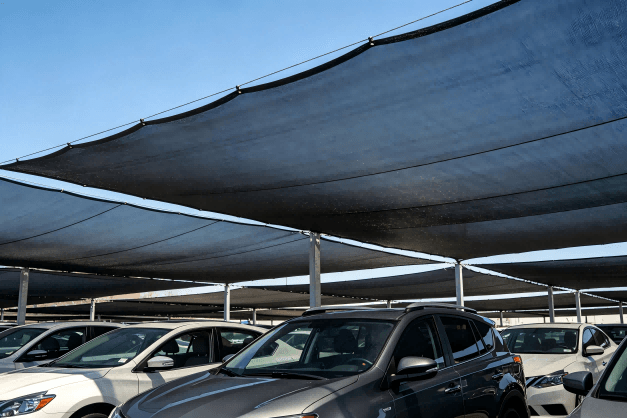
Commercial vehicle parking facilities—including automotive dealerships, rental fleet lots, and logistics distribution hubs—require heavy-duty shade netting to prevent accelerated asset depreciation caused by intense solar radiation and kinetic weather events. Unlike solid steel or PVC roofs, high-density polymer meshes provide breathable thermal mitigation, dropping interior cabin temperatures by up to 20°C while protecting automotive clear coats from severe photo-oxidation and shielding windshields from catastrophic hail damage. For enterprise fleet managers, deploying an engineered Outdoor Shade Net over staging areas is a mandatory capital preservation strategy. It lowers air conditioning idling fuel costs, drastically reduces weather-related insurance premiums, and ensures that high-value commercial inventory remains in showroom condition despite continuous environmental exposure.
Table of Contents
- 1. The Physics of Automotive Solar Degradation
- 2. Thermal Mitigation and Fleet Operational Efficiency
- 3. Kinetic Impact Resistance: Hail and Aerial Debris Protection
- 4. Aerodynamics and Structural Engineering of Parking Canopies
- 5. Commercial Data: Asset Depreciation vs. Protection Matrix
- 6. Enterprise Procurement: The Manufacturing Advantage
- 7. Fleet Parking Canopy Frequently Asked Questions (FAQ)
The Physics of Automotive Solar Degradation
Commercial vehicles stored in open lots are subjected to relentless ultraviolet (UV) bombardment. The automotive clear coat, which protects the underlying base paint, is highly susceptible to UV-A and UV-B radiation. When high-energy solar photons strike an unprotected vehicle, they break the molecular bonds within the clear coat’s resin through a process known as photo-oxidation.
Over months of open-field storage, this continuous molecular cleavage leads to clear coat delamination, paint fading, and micro-cracking. Furthermore, ultraviolet light penetrates automotive glass, attacking the dashboard polyurethane, leather upholstery, and steering wheel adhesives, causing them to off-gas, warp, and crack.
Deploying a high-density Shade Net engineered from 100% virgin High-Density Polyethylene (HDPE) intercepts up to 95% of these damaging UV rays. By filtering out the destructive radiation spectrum before it touches the vehicle surface, the textile acts as a permanent environmental shield, ensuring that logistics fleets and dealership inventories do not suffer from rapid cosmetic depreciation before they are ever sold or dispatched.
Thermal Mitigation and Fleet Operational Efficiency
Automobiles act as highly efficient solar thermal collectors. When short-wave infrared radiation passes through the windows, it is absorbed by the dark interior surfaces and re-radiated as long-wave thermal energy. Because glass blocks long-wave radiation from escaping, the vehicle experiences an extreme greenhouse effect. On a 32°C (90°F) day, the interior cabin temperature of an unprotected commercial vehicle can exceed 60°C (140°F) within 60 minutes.
This extreme thermal loading creates severe operational inefficiencies for rental car agencies and logistics hubs. When a driver enters a superheated vehicle, the air conditioning system must run at maximum load for extended periods to lower the cabin temperature to safe operational levels. This “AC idling” consumes millions of gallons of wasted fuel annually across large commercial fleets.
A heavy-duty mesh canopy physically intercepts solar heat flux. By absorbing and reflecting solar radiation above the lot, the netting drops ambient surface temperatures and prevents the greenhouse effect from triggering inside the vehicles. The result is a drastically cooler microclimate that protects onboard electronics, preserves battery life in Electric Vehicle (EV) fleets, and slashes pre-dispatch cooling times.
Kinetic Impact Resistance: Hail and Aerial Debris Protection
For automotive dealerships and open-air staging facilities, hailstorms represent catastrophic financial events. A brief, 10-minute hailstorm can dent body panels and shatter windshields across hundreds of vehicles, resulting in millions of dollars in insurance claims, inventory write-offs, and lost sales.
Solid metal roofs provide hail protection but are prohibitively expensive for multi-acre lots. The superior alternative is an industrial-grade, warp-knitted canopy. Unlike rigid materials, a lockstitch knitted polymer possesses inherent multidirectional elasticity. When a high-velocity hailstone strikes the net, the interlocking loops expand to absorb and dissipate the kinetic energy of the impact. The hailstone harmlessly bounces off or is caught within the netting matrix, completely neutralizing the threat to the vehicles below.
To guarantee protection, facility engineers must specify netting with a high hydraulic bursting strength (verified via ASTM D3786 testing). Premium monofilament nets will confidently arrest golf-ball-sized hail, paying for themselves entirely during a single severe weather event.
Aerodynamics and Structural Engineering of Parking Canopies
Spanning a multi-acre parking lot requires massive cantilevered steel structures or tensioned cable grids. The critical engineering challenge in these designs is managing aerodynamic wind drag.
If solid canvas or PVC tarpaulins are utilized, they act as massive sails. During a storm, the wind creates severe uplift forces that can uproot concrete footings, warp steel girders, and collapse the entire structure onto the vehicles.
A high-density polyethylene mesh solves this aerodynamic dilemma through controlled porosity. By allowing 15% to 25% of ambient air to pass through its micro-apertures, the netting fractures high-velocity wind currents. This porosity drastically lowers the overall drag coefficient and uplift pressure applied to the support columns. The canopy breathes during extreme weather, safeguarding both the structural integrity of the steel frame and the automotive assets parked beneath it.
Commercial Data: Asset Depreciation vs. Protection Matrix
The following matrix contrasts the operational realities of storing commercial vehicle fleets across three distinct facility setups, highlighting the return on investment generated by heavy-duty netting.
| Fleet Protection Metric | Unprotected Open Asphalt Lot | Solid Steel Carport Roof | Heavy-Duty HDPE Shade Netting |
|---|---|---|---|
| UV & Photo-Oxidation Control | Zero. High rate of clear coat failure and interior fading. | Complete vertical block; vulnerable to angled sun exposure. | 90%+ UV block. Highly effective at preventing cosmetic depreciation. |
| Cabin Thermal Mitigation | Poor. Interior temps exceed 60°C. High AC idling costs. | Good, but solid roofs can trap rising convective heat. | Excellent. Breathable mesh vents hot air, keeping cabins near ambient temps. |
| Hail & Kinetic Impact Defense | Zero. 100% vulnerability to catastrophic inventory damage. | Complete defense, but steel panels dent heavily under impact. | Complete defense. Elastic loops absorb kinetic energy with zero material denting. |
| Structural Aerodynamic Drag | N/A | High. Massive uplift force requires expensive deep concrete footings. | Low. Porous fabric bleeds wind pressure, allowing for lighter, cheaper steel frames. |
| Capital Expenditure (CapEx) | Lowest initial cost, highest insurance & depreciation costs. | Prohibitively expensive for large-scale, multi-acre deployment. | Highly cost-effective. Best ROI for rapid deployment over massive fleet staging areas. |
Enterprise Procurement: The Manufacturing Advantage
To secure enterprise-grade reliability over multi-million dollar vehicle inventories, procurement directors must bypass generic retail plastics and source strictly from heavy-industry extrusion specialists.
As an internationally verified Shade Net manufacturer located in Lizhuang, China, Xinhang engineers structural parking canopies designed to survive extreme weathering. By refusing to use recycled regrind, Xinhang utilizes exclusively 100% Virgin HDPE compounded with maximum concentrations of Hindered Amine Light Stabilizers (HALS). This chemical synergy guarantees the polymer will not become brittle and shatter, providing 5 to 10 years of robust photo-oxidation resistance.
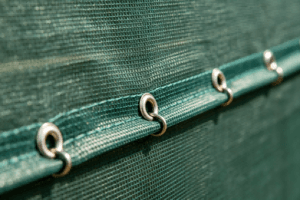
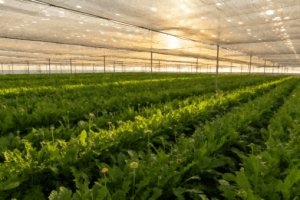
Furthermore, while an Agricultural Shade Net is primarily designed for lightweight plant protection, Xinhang’s commercial parking nets are extruded with heavy-gauge monofilaments and processed using true-width thermal annealing. Every panel is custom-fabricated to match the exact architectural dimensions of the dealership or logistics lot, finished with multi-layered heavy-duty webbing and rust-proof brass grommets. This ensures that the massive tensile loads required to keep the canopy drum-tight and hail-proof are perfectly distributed, securing the ultimate safety of your automotive assets.
Fleet Parking Canopy Frequently Asked Questions (FAQ)
Q1: Do commercial parking nets comply with municipal fire codes?
Standard HDPE will melt when exposed to open flame. However, for commercial parking applications, manufacturers can extrude the polymer with specialized Flame-Retardant (FR) additives. These FR-treated nets comply with rigorous safety standards (such as NFPA 701), ensuring they self-extinguish and do not accelerate a fire in the event of a vehicle combustion incident.
Q2: Exactly how much cooler will a vehicle cabin be under a heavy-duty net?
By blocking up to 90% of direct solar heat flux, a high-quality parking net can reduce the exterior surface temperature of the car’s steel roof by 25°C to 30°C. Consequently, the interior cabin temperature will drop by 15°C to 20°C compared to a vehicle parked in direct sunlight, drastically reducing AC load times and protecting dashboard electronics.
Q3: Can a knitted shade net genuinely stop large, golf-ball-sized hail?
Yes. The mechanical secret lies in the warp-knitted lockstitch design. Unlike rigid roofs that dent, the elastic polymer loops of a high-density net act like a trampoline. They catch the hailstone, stretch to absorb the kinetic velocity, and bounce the hail away or cradle it safely, completely preventing glass breakage and panel denting.
Q4: Does the color of the net matter for automotive parking lots?
Yes, for both aesthetic and thermodynamic reasons. Silver and white nets reflect a significant portion of solar near-infrared (NIR) radiation back into the atmosphere, keeping the air beneath the canopy exceptionally cool. Black nets offer maximum UV longevity but absorb heat; they must be installed with sufficient vertical clearance to allow convective winds to blow that trapped heat away from the vehicles.
Q5: Why should I choose netting over a solid metal carport structure?
Solid metal structures create massive aerodynamic uplift forces, requiring huge, expensive steel columns and deep concrete footings. Netting is aerodynamically porous, shedding wind load and allowing for lighter, significantly more cost-effective support frames. Additionally, netting does not trap exhaust fumes and radiant heat the way solid flat roofs do.
Q6: How is the fabric tensioned securely over large commercial car lots?
Commercial installations utilize heavy-duty galvanized steel cables or structural aluminum lock channels. The net, featuring factory-installed heavy webbing and brass grommets, is attached to these cables using high-strength turnbuckles or polymer butterfly clips, allowing installers to crank the material drum-tight to eliminate wind flutter.
Q7: Will bird droppings and tree sap wash off the netting easily?
HDPE is a highly hydrophobic material, meaning it absorbs zero water and resists chemical staining. Acidic bird droppings, tree sap, and atmospheric dust will not permanently bond to the polymer filaments. The canopy can be easily cleaned using a low-pressure water hose and mild detergent without damaging the structural integrity.
Q8: What is the realistic operational lifespan of a commercial parking net?
When manufactured using 100% virgin HDPE and heavy HALS UV-stabilizers, an enterprise-grade parking net is engineered to last 5 to 10 years in extreme, high-radiation environments like the Middle East or the American Southwest. Proper installation tension to prevent wind chafing is critical to achieving this maximum lifespan.
References & Industrial Fleet Standards:
- Automotive Asset Protection and Hail Defense Mechanisms: Shade Cloth Store Commercial Solutions
- Polymer Thermodynamics and Aerodynamic Wind Load Integration: Greenhouse Megastore Structural Hardware Specs
- HDPE Solar Degradation and HALS Chemical Efficiency: Farm Plastic Supply Material Science Reports