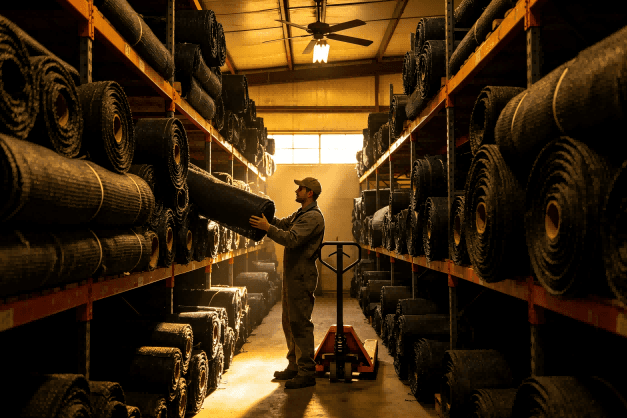
Procuring heavy-duty commercial shading at scale requires bypassing retail distributors and engaging directly with primary polymer extrusion manufacturers. The ultimate buying guide for wholesale shade netting hinges on validating three critical industrial metrics: the purity of the High-Density Polyethylene (HDPE) base resin, the quantitative mass density (GSM) relative to the specified shade percentage, and the verifiable concentration of Hindered Amine Light Stabilizers (HALS). Purchasing based solely on price-per-roll inevitably results in acquiring degraded, recycled plastics that suffer rapid photo-oxidation and catastrophic tensile failure within a single season. By establishing strict B2B procurement tolerances—including true-width extrusion formatting, double-lockstitch architecture, and custom edge selvedge reinforcement—enterprise agricultural operations and industrial project managers can secure a Shade Net supply chain that guarantees a 5 to 10-year operational lifecycle, drastically lowering total capital expenditure.
Table of Contents
- 1. Deconstructing the Supply Chain: Manufacturer vs. Trading Company
- 2. Core Material Specifications: Virgin HDPE vs. Recycled Regrind
- 3. Validating UV Stabilization: The HALS Requirement
- 4. Understanding GSM (Grams per Square Meter) and Density Fraud
- 5. B2B Wholesale Procurement Checklist
- 6. Frequently Asked Questions (FAQ) for Wholesale Buyers
Deconstructing the Supply Chain: Manufacturer vs. Trading Company
The global technical textile market is saturated with intermediary trading companies that rebrand and markup generic, mass-produced rolls. For large-scale procurement, buying from a trader introduces severe operational risks: inconsistent material quality between batches, inability to customize chemical UV profiles, and a total lack of structural accountability when a product fails in the field.
To secure enterprise-grade infrastructure, procurement teams must audit the supply chain and contract directly with a primary factory. A true Shade Net manufacturer owns the entire production vertical. They control the resin compounding, the filament extrusion, the warp-knitting machines, and the final edge-sewing processes. This direct oversight allows B2B buyers to dictate exact tensile strength requirements, custom roll widths, and specific photo-selective color matching, ensuring the final product aligns perfectly with the engineering demands of the project.
Core Material Specifications: Virgin HDPE vs. Recycled Regrind
The most common method low-tier suppliers use to manipulate wholesale pricing is substituting virgin polymer with recycled plastic (regrind).
Recycled High-Density Polyethylene has already endured severe thermal stress during its initial manufacturing and subsequent remelting. This thermal history breaks down the long, linear hydrocarbon chains that give HDPE its legendary strength. Furthermore, recycled batches contain microscopic impurities and heavy metals that act as internal catalysts for rapid photo-oxidation. An Agricultural Shade Net woven from recycled plastic will become chalky, stiff, and highly brittle within 12 to 18 months, shattering at the first sign of aerodynamic wind shear.
Wholesale procurement contracts must explicitly stipulate the use of 100% Virgin HDPE. Virgin resin provides a flawless, highly crystalline macromolecular structure, ensuring the final knitted matrix retains its multidirectional elasticity and supreme hydraulic bursting strength for years.
Validating UV Stabilization: The HALS Requirement
Even pure virgin HDPE will degrade if exposed to naked solar radiation. The polymer must be chemically armored.
Do not accept generic claims of “UV Treated.” The procurement specification must mandate the inclusion of Hindered Amine Light Stabilizers (HALS). HALS are advanced chemical additives mixed into the masterbatch prior to extrusion. They do not merely absorb light; they act as continuous free-radical scavengers. When a UV photon cleaves a polymer bond, the HALS molecule instantly neutralizes the resulting free radical, preventing the chain reaction of material degradation.
A reputable manufacturer will provide QUV Accelerated Weathering Test data. This independent laboratory testing subjects the fabric to intense, concentrated UV radiation and moisture cycles, simulating 5 to 10 years of harsh outdoor exposure in a matter of weeks, proving the efficacy of the HALS compound.
Understanding GSM (Grams per Square Meter) and Density Fraud
Mass density is measured in Grams per Square Meter (GSM). It dictates the physical weight and thickness of the netting. A critical wholesale scam involves “stretched-width processing.”
A supplier may extrude a net at 6 meters wide but mechanically stretch it onto an 8-meter roller to sell it as a larger, higher-margin product. This stretches the individual yarns dangerously thin, drastically lowering the GSM and compromising the tensile strength. Worse, when this stretched net is installed in the field, the heat of the sun causes the polymer to reset its thermal memory. The 8-meter net violently shrinks back to 6 meters, ripping the attachment grommets out of the support cables.
Enterprise buyers must require True-Width Extrusion and verify the exact GSM weight against the ordered shade percentage. If you order an 80% shade net, the GSM should correspond appropriately (e.g., 120g – 150g/m2). If a supplier offers an 80% net that weighs only 60g/m2, the yarns are over-stretched, and the product will fail.
B2B Wholesale Procurement Checklist
Utilize the following matrix as a strict auditing tool when negotiating bulk procurement contracts with global suppliers.
| Audit Parameter | Minimum Acceptance Standard | Risk of Non-Compliance |
|---|---|---|
| Polymer Purity | 100% Virgin High-Density Polyethylene (HDPE). | Rapid photo-oxidation, brittleness, and tearing within 12 months. |
| Chemical Stabilization | Documented inclusion of HALS additives. | Total loss of tensile elasticity under solar load. |
| Structural Topography | Warp-knitted lockstitch (No woven grids for high-wind). | Catastrophic unravelling and line-tear propagation if punctured. |
| Dimensional Accuracy | True-Width Extrusion (Verified GSM per shade %). | Severe heat shrinkage leading to ripped mounting hardware. |
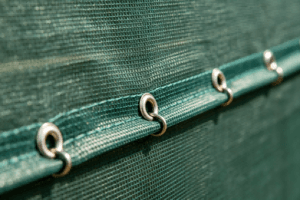
| Edge Reinforcement | Multi-layer polyester webbing with set brass grommets. | Inability to apply necessary mechanical tension; edge fraying. |
Frequently Asked Questions (FAQ) for Wholesale Buyers
Q1: How can I visually tell if a shade net is made from recycled regrind plastic?
Virgin HDPE possesses a natural, vibrant sheen and feels supple and elastic to the touch. Recycled plastic nets often look dull, feel stiff or brittle right out of the packaging, and may emit a strong, unpleasant chemical odor due to mixed impurities. However, the most reliable verification is requesting raw material certificates from the factory.
Q2: What is the Minimum Order Quantity (MOQ) typically required for custom factory orders?
For specialized extrusion—such as custom photo-selective colors, exact architectural dimensions, or specific GSM weights—true manufacturers like Xinhang typically require an MOQ ranging from a 20-foot container to roughly 30,000 square meters. This ensures the masterbatch compounding and machine calibration processes are economically viable.
Q3: Should I order raw rolls and cut them on-site, or order pre-finished panels?
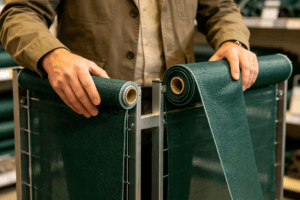
For large-scale agricultural operations or precise commercial architecture, ordering factory-finished modular panels is vastly superior. Factory panels arrive pre-shrunk with heavy-duty reinforced edges and grommets ready for immediate hoisting. Cutting raw rolls on-site results in unreinforced edges that cannot support tension, leading to up to 15% material waste and guaranteed wind damage.
Q4: How do logistics work when importing bulk shade netting internationally?
Outdoor Shade Net rolls are tightly compressed and packaged in heavy-duty poly-bags. Because HDPE is lightweight but voluminous, shipping is calculated by cubic volume (CBM) rather than raw weight. A standard 40-foot High Cube (40HQ) container can typically hold between 10,000 to 14,000 kilograms of netting, depending on the GSM and roll dimensions.
Q5: Can I request sulfur-resistant netting for my commercial greenhouse?
Yes, and you absolutely must if you use sulfur evaporators for pest control. Standard HALS additives are deactivated by acidic sulfur vapors. When negotiating with a primary manufacturer, specify that the masterbatch must be compounded with specialized, sulfur-resistant UV stabilizers (often referred to as SR-HALS) to ensure the net’s lifespan is not destroyed by your agrochemical routine.
References & B2B Procurement Standards:
- Polymer Supply Chain and Wholesale Verification: Shade Cloth Store Wholesale Guidelines
- HALS Compounding and QUV Testing Protocols: Greenhouse Megastore Material Standards
- True-Width Extrusion and Tension Mechanics: Farm Plastic Supply Manufacturing Data