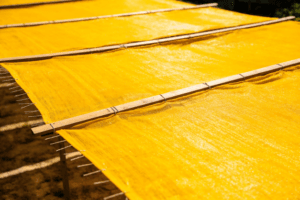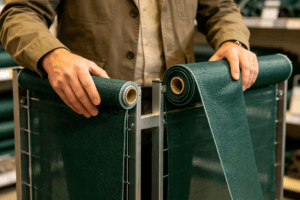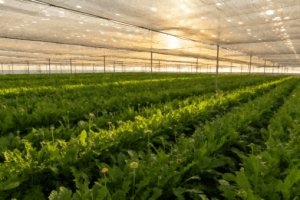
The tensile strength of heavy-duty shade netting defines the maximum mechanical stress the polymer matrix can endure before experiencing catastrophic structural failure or filament rupture. In commercial agriculture and industrial architecture, this metric directly dictates a canopy’s ability to survive sustained dynamic wind shear, severe hail impacts, and heavy suspension tension over multi-acre structural grids. High tensile strength is achieved by extruding 100% virgin High-Density Polyethylene (HDPE) into calibrated monofilaments, which are subsequently interwoven using advanced warp-knitting technology. For enterprise procurement managers, evaluating the precise tensile force limits—measured via the ASTM D5034 Grab Test—is the fundamental baseline for selecting an Outdoor Shade Net that guarantees infrastructure security, mitigates aerodynamic drag, and ensures a profitable return on investment across a multi-year deployment cycle.
Table of Contents
- 1. The Physics of Tensile Strength in Polymer Extrusions
- 2. Structural Topography: Warp-Knitting vs. Woven Load Distribution
- 3. Environmental Degradation of Tensile Capacity
- 4. Engineering the Borders: Selvedges and Fastening Mechanics
- 5. Commercial Data: Tensile Performance and Yield Matrix
- 6. Enterprise Manufacturing Standards
- 7. Frequently Asked Questions (FAQ) on Material Strength
The Physics of Tensile Strength in Polymer Extrusions
Tensile strength is not merely a measure of thickness; it is an evaluation of macromolecular architecture. In industrial textiles, tensile strength represents the exact pulling force—usually measured in Newtons (N) or pounds-force (lbf)—required to break a specified width of the material.
The baseline strength of any Shade Net originates in the extrusion phase. High-Density Polyethylene (HDPE) is the global standard because its molecular structure consists of long, linear hydrocarbon chains with minimal branching. During the extrusion process, the molten polymer is stretched and rapidly cooled (annealed). This mechanical drawing process forces the molecular chains to align longitudinally, creating a highly crystalline internal structure that maximizes the filament’s resistance to longitudinal pulling forces.
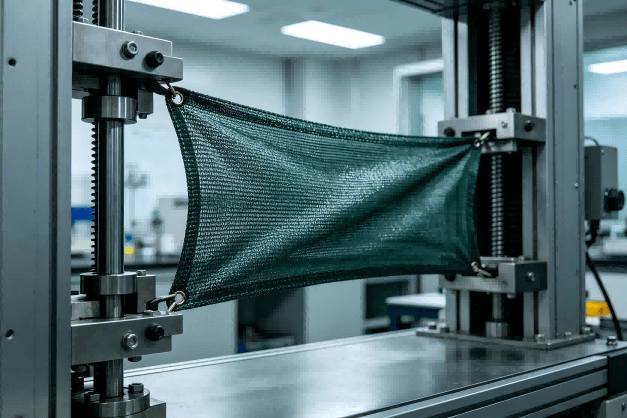
Industrial testing utilizes the ASTM D5034 Grab Test. In this procedure, mechanical jaws clamp a specific sample width and pull in opposite directions until the fabric tears. Premium heavy-duty meshes must consistently demonstrate a tensile strength exceeding 450 N in the warp direction (machine direction) and 350 N in the weft direction (cross-machine direction). When a manufacturer utilizes recycled or regrind plastic, the shortened, pre-broken polymer chains result in a fabric that fails these mechanical thresholds, leading to rapid tearing under standard field conditions.
Structural Topography: Warp-Knitting vs. Woven Load Distribution
Raw filament strength must be effectively translated into an expansive architectural panel. The method of interlacing these filaments dictates how the finished canopy handles massive, sudden spikes in kinetic energy, such as a severe storm gust or a falling tree branch.
Woven Configurations and Brittle Failure
Woven textiles intersect warp and weft yarns at rigid 90-degree angles. While this provides excellent dimensional stability under low stress, it severely limits polymer elongation. When a sudden wind gust hits a woven net, the rigid grid cannot stretch. 100% of the kinetic force is instantly transferred to the anchoring points. If the force exceeds the tensile threshold of the weakest yarn, that yarn snaps. Because woven threads rely purely on friction to hold together, the breaking of one thread causes the surrounding grid to instantly unravel, resulting in a catastrophic linear tear across the entire panel.
Lockstitch Knitting and Dynamic Load Absorption
Industrial-grade Agricultural Shade Net utilizes warp-knitting machinery to create interlocking loops. This geometry provides inherent, multidirectional elasticity. When a heavy wind load impacts a knitted canopy, the individual loops deform and stretch slightly. This localized stretching absorbs the kinetic shockwave, dissipating the force over a wide area before it can reach the perimeter fasteners.
Furthermore, the lockstitch pattern isolates damage. If a sharp hailstone exceeds the material’s bursting strength and punctures a hole, the interlocking loops lock the severed threads in place, preventing the puncture from propagating into a massive tear. This localized containment is the defining feature of heavy-duty reliability.
Environmental Degradation of Tensile Capacity
A canopy may demonstrate exceptional tensile strength on the day of installation, but its ability to retain that load-bearing capacity over five to ten years depends entirely on its chemical defense against environmental weathering.
The most aggressive destroyer of tensile strength is photo-oxidation. Ultraviolet (UV) photons carry enough quantum energy to physically cleave the carbon-hydrogen bonds within the HDPE matrix. As the long molecular chains are chopped into shorter fragments, the polymer loses its flexibility and tensile capacity, becoming brittle and chalky. A single high-wind event will easily shatter a photo-oxidized panel.
To arrest this degradation, premium nets are compounded with Hindered Amine Light Stabilizers (HALS) during the molten extrusion phase. HALS additives function as highly efficient free radical scavengers. When a UV photon breaks a polymer bond, the HALS molecule instantly neutralizes the resulting free radical before it can trigger a cascading chain reaction of material degradation. This chemical integration ensures the mesh retains over 90% of its original tensile strength even after 60 months of intense solar exposure.
Engineering the Borders: Selvedges and Fastening Mechanics
In commercial field applications, the center of the netting panel rarely fails first. The overwhelming majority of tensile failures occur at the perimeter edges, where the flexible fabric meets the rigid steel suspension cables or galvanized frame. The interface between these two materials concentrates extreme shear forces.
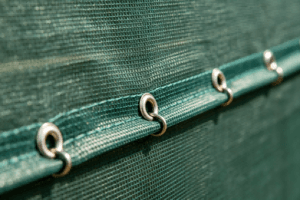
To prevent localized pull-outs, the perimeter of the net must be heavily engineered. Raw, heat-sealed edges are insufficient for heavy-duty applications. Procurement specifications must mandate heavy-duty selvedge reinforcement. This involves folding the edge of the mesh and sewing a thick, UV-stabilized polyester or high-density PE webbing tape along the entire perimeter.
Solid brass or stainless-steel grommets are then hydraulically punched through this reinforced webbing at precise intervals (typically every 50 cm). When the installation crew applies mechanical tension via turnbuckles or bungee fasteners, the load is distributed evenly along the polyester webbing rather than tearing at individual HDPE micro-filaments. This perimeter engineering is essential for spanning large acreage without catastrophic edge ruptures.
Commercial Data: Tensile Performance and Yield Matrix
The following matrix outlines the standardized mechanical thresholds required to survive varying levels of industrial and agricultural stress, verified through standard grab and burst testing protocols.
| Application Profile | Required Mass Density (GSM) | Min. Warp Tensile Strength (N) | Primary Structural Threat |
|---|---|---|---|
| Interior Greenhouse Screening | 50g – 80g | ≥ 200 N | Motorized track friction; heat-induced shrinkage. |
| Open-Field Crop Canopy | 90g – 150g | ≥ 400 N | Aerodynamic wind shear; heavy rain accumulation. |
| Hail Protection & Orchards | 120g – 180g (Monofilament) | ≥ 550 N | Kinetic blunt force impact; severe cyclic storm loading. |
| Construction / Commercial Parking | 180g – 340g+ | ≥ 800 N | Typhoon-level uplift forces; abrasive particulate damage. |
Enterprise Manufacturing Standards
To ensure maximum structural reliability, commercial buyers must audit the primary manufacturer’s extrusion and weaving protocols. Purchasing generic rolls from secondary trading entities routinely results in material failure, as these companies lack traceability regarding the base polymer’s purity and chemical stabilization profile.
Operating from Lizhuang, the premier industrial netting hub, Xinhang stands as a globally verified Shade Net manufacturer. We guarantee that every heavy-duty panel is extruded from 100% virgin HDPE, achieving flawless macromolecular alignment for supreme tensile load capacity. By integrating state-of-the-art warp-knitting machinery, Xinhang produces true-width, heat-set textiles that refuse to shrink or unravel under extreme environmental duress. Combined with custom edge engineering and strict GSM compliance, Xinhang delivers agricultural and industrial canopies that actively secure capital investments against the harshest weather events on the planet.
Frequently Asked Questions (FAQ) on Material Strength
Q1: How does the GSM (Grams per Square Meter) relate to tensile strength?
GSM measures the physical mass and density of the polymer matrix. While a higher GSM generally indicates thicker filaments and a tighter knit—translating to higher tensile strength and burst resistance—it is not the only factor. A 150 GSM net made from virgin HDPE will significantly outperform a 200 GSM net made from recycled, degraded plastics. Both virgin polymer purity and knitting topography are required to maximize the strength of a high-GSM fabric.
Q2: Why does a heavy-duty net need to stretch during installation?
A net that cannot stretch will fail under heavy wind loads. Lockstitch knitted nets are designed with 1.5% to 3% elongation elasticity. Installers must stretch the net to apply a baseline mechanical tension (making it drum-tight). This tension eliminates aerodynamic flutter—the violent shaking that causes friction tears. When a storm hits, the tight, elastic mesh absorbs the kinetic energy dynamically rather than transferring sudden, rigid shocks to the steel mounting poles.
Q3: What causes a commercial shade net to suddenly become brittle and tear?
Sudden brittleness is the hallmark of advanced photo-oxidation. When UV radiation breaks down the polymer chains, the plastic loses its elasticity and mechanical strength. This happens rapidly if the manufacturer used recycled plastics or failed to incorporate sufficient Hindered Amine Light Stabilizers (HALS) during extrusion. Chemical exposure to vaporized sulfur in greenhouses can also deactivate the UV stabilizers, leading to premature brittleness.
Q4: How can I prevent the attachment eyelets from ripping out of the fabric?
Never punch a hole or attach a fastener directly into the raw mesh fabric. The immense pulling force of the installation cables will instantly shear through the micro-filaments. Always procure netting with factory-sewn, multi-layered polyester selvedge webbing. The brass grommets (eyelets) must be hydraulically stamped through this thick webbing, which successfully distributes the massive tensile load across the entire edge of the panel.
References & Industry Technical Standards:
- ASTM D5034 Tensile Strength Evaluation Protocols: Greenhouse Megastore Material Standards
- Polymer Extrusion and Lockstitch Load Mechanics: Greenpro Ventures Structural Analysis
- Edge Reinforcement and Aerodynamic Drag Mitigation: Farm Plastic Supply Field Implementation