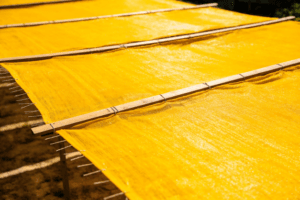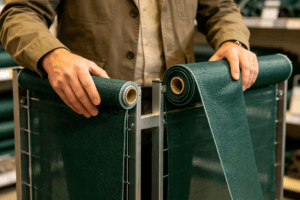
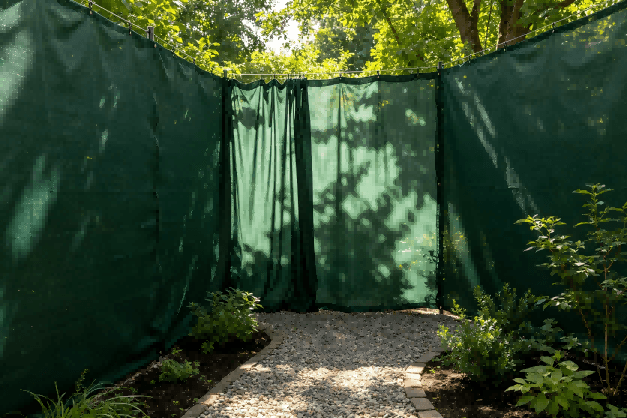
A 90% heavy-duty shade netting creates maximum privacy barriers by utilizing an ultra-dense, hybridized extrusion geometry—combining flat tape yarns with robust round monofilaments—to achieve total optical opacity while maintaining structural porosity. Unlike solid vinyl fencing or wood panels that block airflow entirely and collapse under aerodynamic wind shear, an engineered 90% Shade Net allows 10% of ambient wind to pass through its lockstitch micro-apertures. This precise ratio drastically reduces the drag coefficient on the perimeter fencing, preventing structural uplift. For commercial facilities, residential estates, and industrial construction sites, deploying this 90% High-Density Polyethylene (HDPE) barrier ensures complete visual obstruction from pedestrians and competitors, blocks severe lateral UV radiation, and functions as an unparalleled environmental shield against dust and debris transfer.
Table of Contents
- 1. The Optical Physics of 90% Opacity Integration
- 2. Aerodynamic Stability: Beating the “Sail Effect”
- 3. Industrial Dust and Particulate Containment
- 4. Microclimate Regulation in Commercial Zones
- 5. Privacy Barrier Application Matrix
- 6. Enterprise Procurement: Sourcing True Density
- 7. Frequently Asked Questions (FAQ) on Privacy Netting
The Optical Physics of 90% Opacity Integration
Achieving true visual privacy requires more than simply weaving thick plastic. To create an effective barrier, the netting must manipulate ambient light to prevent the human eye from resolving shapes on the opposite side.
A 90% density netting is manufactured by maximizing the surface area of the polymer matrix. High-end manufacturers utilize a hybrid extrusion geometry. They weave thick, round monofilament yarns vertically to provide extreme bursting strength, and intertwine them with flat tape yarns horizontally. These flat ribbons overlap tightly within the warp-knitted lockstitch, physically obstructing 90% of all incoming visible light and ultraviolet photons.
Because only 10% of light penetrates the barrier, the human eye on the exterior struggles to gather enough photon data to form a coherent image, resulting in a dark, opaque blur. Whether attempting to shield high-value industrial inventory from public view or protecting a luxury residential tennis court, this specific macromolecular density guarantees total optical occlusion.
Aerodynamic Stability: Beating the “Sail Effect”
The primary engineering flaw with solid privacy barriers (such as wood, corrugated metal, or PVC tarpaulins) is their aerodynamic behavior. A solid wall acts as a massive sail. When high-velocity wind hits a solid barrier, it creates extreme positive pressure on the windward side and a powerful vacuum vortex on the leeward side. This pressure differential exerts violent lateral force on the fence posts, frequently snapping metal poles at the concrete footing during a storm.
An engineered 90% Outdoor Shade Net eliminates this catastrophic failure. Despite its visual opacity, the lockstitch matrix remains highly porous. As wind strikes the netting, the polymer filaments fracture the kinetic energy of the air, allowing a controlled 10% to 15% of the wind volume to bleed through the micro-apertures.
This “bleeding” effect neutralizes the pressure differential, drastically lowering the overall drag coefficient. Facility managers can deploy 90% netting on standard chain-link fences or temporary scaffolding without requiring the expensive, deep concrete footings necessary to support solid walls, significantly reducing site preparation costs.
Industrial Dust and Particulate Containment
For commercial construction zones, mining facilities, and bulk material handling sites, privacy is secondary to environmental compliance. Local municipalities strictly regulate the dispersion of fugitive dust (PM10 and PM2.5 particulate matter) into surrounding neighborhoods.
A 90% density barrier acts as a highly efficient mechanical filtration system. As wind passes through the dense polymer matrix, the interlocking fibers act as a sieve, physically trapping airborne dust, silica, and debris. The wind speed immediately drops on the leeward side of the net, creating a “dead air” zone where heavier particles instantly fall out of suspension and drop to the ground. Utilizing 90% netting as a perimeter fence ensures environmental compliance and shields adjacent properties from aggressive industrial pollution.
Microclimate Regulation in Commercial Zones
Beyond fencing, 90% netting is frequently deployed as an overhead canopy in specialized commercial sectors, fundamentally altering the underlying thermodynamic state of the environment.
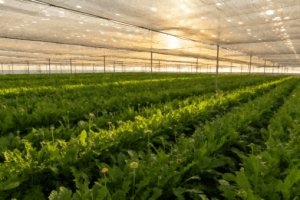
- Agricultural Ginseng & Medicinal Cultivation: Very few plants can survive under a 90% canopy, as it blocks nearly all Photosynthetically Active Radiation (PAR). However, highly sensitive understory medicinal crops, like Ginseng, require massive thermal insulation and almost total darkness to prevent photoinhibition and root stagnation.
- Livestock & Poultry Confinement: Farm animals do not require sunlight for photosynthesis. A 90% net strung over cattle feedlots or poultry enclosures intercepts massive amounts of solar heat flux, dropping ambient temperatures by 10°C to 15°C. This aggressive cooling prevents heat exhaustion, maintaining high feed-conversion ratios during extreme summer months.
- Commercial Vehicle Parking: Dealerships and logistics hubs use 90% netting to protect the clear coats of their vehicle inventory from severe photo-oxidation, ensuring assets do not cosmetically depreciate while sitting on the asphalt.
Privacy Barrier Application Matrix
To maximize the return on investment, procurement teams must align the 90% density specification with the correct physical application.
| Target Application | Primary Functional Benefit | Installation Requirement |
|---|---|---|
| Construction Site Perimeter | Total visual obstruction and fugitive dust containment. | Vertical mounting on chain-link fences using heavy-duty zip ties and factory grommets. |
| Luxury Tennis Courts / Sports Facilities | Eliminates visual distractions and acts as a severe windbreak for ball control. | Requires drum-tight tensioning to prevent aerodynamic flutter and noise. |
| Livestock / Feedlot Overheads | Maximum thermal reduction; prevents animal heat stress. | Overhead cable suspension; requires extreme tensile burst strength for high winds. |
| Residential Estates | High-end visual privacy from neighbors without building code permits for solid walls. | Often deployed over existing iron or wire fencing as an aesthetic upgrade. |
Enterprise Procurement: Sourcing True Density
Achieving 90% opacity requires a massive volume of raw polymer. The market is rife with substandard products that advertise “90% Shade” but weigh less than 100 grams per square meter (GSM). These nets are mechanically stretched during production, creating gaping holes that fail to provide privacy and shatter under wind pressure.
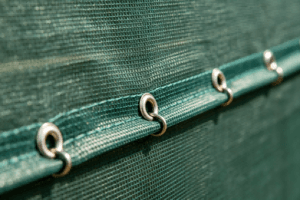
To secure true privacy barriers, commercial buyers must source directly from verified extrusion specialists. Operating from the industrial center of Lizhuang, Xinhang is a premier Shade Net manufacturer that guarantees rigorous GSM compliance. We extrude our high-density privacy meshes exclusively from 100% Virgin HDPE, heavily infused with Hindered Amine Light Stabilizers (HALS). This guarantees that your 90% barrier will not suffer from photo-oxidation or color fading, maintaining its total opacity and structural dignity for 5 to 7 years in the harshest global climates. Every roll is finished with customized, multi-layered selvedge borders and brass grommets, providing the flawless tensile strength required for professional perimeter installations.
Frequently Asked Questions (FAQ) on Privacy Netting
Q1: Can people see through a 90% shade net at night if lights are on inside?
At night, if the area behind the net is brightly illuminated and the exterior is dark, a silhouette or shadow effect will be visible through the 10% porosity of the mesh. It will not show clear details, but it does not provide 100% blackout capability against direct backlighting. During daylight hours, it offers complete visual obstruction.
Q2: What is the recommended GSM weight for a true 90% heavy-duty privacy net?
To physically weave enough polymer to block 90% of light, the fabric must carry substantial mass. A legitimate commercial-grade 90% netting should have a Grams per Square Meter (GSM) rating of at least 150g to 220g. Anything lighter has likely been over-stretched and will fail to deliver promised opacity or wind resistance.
Q3: Will a 90% net act as a sound barrier for a busy road?
No. While the dense fabric effectively traps dust and drops wind velocity, it lacks the dense mass required to absorb or reflect acoustic soundwaves. Heavy traffic noise will pass through the micro-apertures. For genuine noise reduction, solid acoustic paneling or dense organic hedgerows are required.
Q4: Can I use a 90% net to grow tomatoes in a hot desert climate?
No. Tomatoes are heliophytic (sun-loving) crops. Even in a desert, blocking 90% of the light will drop the Daily Light Integral (DLI) far below the plant’s survival threshold. The plant will stop flowering, stretch aggressively to find light, and ultimately fail. For tomatoes in a desert, a 40% to 50% density is the absolute maximum recommended.
Q5: How do I install the netting to a chain-link fence properly?
You must purchase the net with factory-finished reinforced edges and brass grommets spaced every 50 cm. Use heavy-duty, UV-stabilized zip ties to attach the grommets to the chain-link wire. It is critical to pull the fabric drum-tight horizontally and vertically during installation; loose fabric will flap against the wire fence and tear itself apart via friction.
Q6: Why is my black privacy net turning white and chalky?
Chalking is the primary physical symptom of severe photo-oxidation. The UV rays have broken down the polymer chains because the manufacturer used cheap, recycled plastics or failed to include Hindered Amine Light Stabilizers (HALS). The netting is structurally dead and will soon shatter under wind pressure. Always specify 100% virgin HDPE to prevent this.
References & Industrial Netting Standards:
- Aerodynamic Drag Coefficient and Windbreak Design: Shade Cloth Store Structural Solutions
- Fugitive Dust Control and Polymer Density Data: Farm Plastic Supply Environmental Specs
- HDPE Opacity Measurements and GSM Verification: Greenhouse Megastore Shade Density Matrix