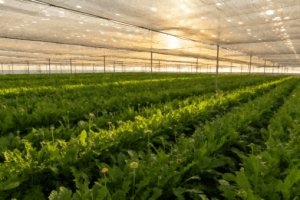
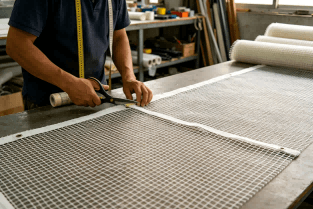
Factory-cut custom shade net solutions provide enterprise operations with immediate, ready-to-install canopy panels that eliminate the structural risks and material waste inherent in on-site field trimming. By leveraging precision manufacturing—including machine-stitched webbing, thermally-set edge selvedges, and CAD-calibrated grommet positioning—commercial growers and industrial contractors ensure a drum-tight, aerodynamically stable installation. While custom-fabricated panels require a longer procurement lead time compared to generic bulk rolls, the total cost of ownership is significantly lower due to the absolute minimization of on-site labor and the elimination of line-tear propagation risks associated with raw-cut edges. Choosing factory-finished solutions transforms a raw Shade Net from a volatile consumable into a precision-engineered structural component.
Table of Contents
- 1. The Structural Hazards of Field-Cut Mesh
- 2. Advantages of Factory-Fabricated Precision Panels
- 3. Balancing Lead Time vs. Operational Efficiency
- 4. Engineering the Edge: Why Selvedge Integrity Matters
- 5. Commercial Data: Waste Mitigation and ROI Comparison
- 6. Sourcing Strategy: Direct Manufacturer Integration
- 7. Frequently Asked Questions (FAQ)
The Structural Hazards of Field-Cut Mesh
Field trimming generic Agricultural Shade Net rolls is a frequent cause of infrastructure failure in commercial construction and large-scale farming. When laborers cut through warp-knitted HDPE mesh on-site, they destroy the factory-sealed border that provides the net’s primary structural stability.
A raw-cut edge leaves thousands of individual polymer threads exposed to aerodynamic wind shear. As the canopy flutters in the wind, these exposed ends suffer from mechanical friction and vibration, eventually unravelling. Once a single thread starts to pull, the entire panel can experience catastrophic line-tear propagation, turning a minor oversight into a multi-hectare canopy failure during the next windstorm. Relying on field-improvised tape or folding techniques to replace factory-sealed borders is inherently unreliable, as these makeshift repairs lack the tensile capacity to handle the loads of a drum-tight installation.
Advantages of Factory-Fabricated Precision Panels
Factory-cut solutions transform the installation process from a complex engineering task into a simple, standardized hoisting sequence. By outsourcing the fabrication to a specialized Shade Net manufacturer, buyers receive:
- Edge Integrity: High-density polyester webbing is machine-sewn along all four sides, creating a structural border that distributes tension across the entire surface rather than individual filaments.
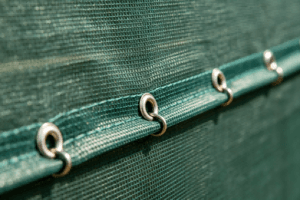
- Grommet Accuracy: Industrial brass or stainless steel grommets are hydraulically stamped through the reinforced webbing at precise intervals, ensuring perfect alignment with the site’s tensioning cables.
- Dimensional Stability: Factory-finished panels undergo controlled thermal annealing, ensuring they do not suffer from the heat-induced shrinkage common in low-tier, stretched-width rolls.
Balancing Lead Time vs. Operational Efficiency
The primary “con” of custom procurement is the lead time. While generic rolls are often “off-the-shelf,” custom panels require factory scheduling, CAD-based panel cutting, and specialized sewing.
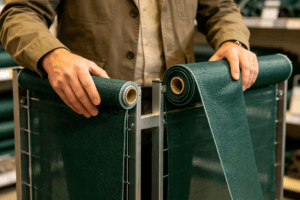
However, procurement engineers view this as a strategic trade-off. The time saved during installation is substantial. When factory-finished panels arrive, the construction crew simply hoists, clips, and tensions the sections. This eliminates the days of measuring, cutting, and hand-sewing that define on-site roll deployment. In large-scale installations (over 5 hectares), the labor cost reduction provided by “plug-and-play” custom panels often dwarfs the additional lead time required for manufacturing, delivering a superior project timeline and higher overall installation quality.
Engineering the Edge: Why Selvedge Integrity Matters
The selvedge is the structural soul of the Outdoor Shade Net. When panels are custom fabricated, this border is engineered to act as a tensile load transfer zone.
In Xinhang’s manufacturing facility, we use high-grade polyester tape that acts as a structural spine. This tape is folded over the HDPE fabric and stitched with high-tenacity, UV-resistant thread using a multi-needle lockstitch system. This ensures that when the site manager applies mechanical tension to the grommets, the pull-force is distributed across the thick polyester webbing rather than straining the individual, thinner HDPE mesh threads. Without this edge engineering, the netting would inevitably fail at the fastener points under any significant wind load.
Commercial Data: Waste Reduction and ROI Matrix
Enterprise procurement shifts the focus from “price-per-roll” to “total-installed-cost.” The matrix below compares the fiscal impact of raw-roll procurement against engineered custom-fabrication.
| Procurement Metric | Generic Raw-Roll Strategy | Custom Factory-Panel Strategy |
|---|---|---|
| Material Efficiency | 85% – 90% (Loss due to seam overlap/trimming). | 99%+ (CAD-optimized panel nesting). |
| Site Labor Requirement | High (Measuring, cutting, sewing). | Low (Hoisting, clipping, tensioning). |
| Infrastructure Integrity | Risk of fraying and localized unravelling. | Secure (Reinforced edges/eyelets). |
| Total Installed Cost | Lower purchase price; higher total project cost. | Higher purchase price; lowest total project cost. |
Sourcing Strategy: Manufacturer Direct vs. Trading
To achieve the precision required for custom-fabricated shade panels, buyers must contract directly with high-volume production facilities. Generic trading companies lack the CAD-design capacity and industrial-grade sewing lines required to fabricate panels that consistently fit multi-span greenhouses or wide-span cable systems.
As a globally verified Shade Net manufacturer based in the industrial hub of Lizhuang, Xinhang operates with full vertical integration. We control the entire life cycle of your product—from the initial compounding of virgin HDPE resin to the final, heat-sealed, grommet-punched panel ready for site delivery. By sourcing direct, enterprise project managers verify polymer purity at the source, enforce structural tolerances before the product is even shipped, and receive the factory-engineered hardware necessary to guarantee that the canopy installation is as secure and efficient as the agricultural goals they support.
Frequently Asked Questions (FAQ)
Q1: How do I know if the custom dimensions I’ve measured are correct?
For critical infrastructure, procurement teams should share their CAD drawings or structural blueprints directly with the factory engineering team. A professional manufacturer will review these dimensions and suggest the necessary tension allowances based on the specific fabric topography you have selected, preventing the common issue of mismeasured panels.
Q2: What is the most common reason for custom panels to be rejected on-site?
Dimensional shrinkage is the primary cause. If the fabric wasn’t thermally set (heat-annealed) to size at the factory, exposure to summer heat will cause the polymer to shrink, resulting in grommets that no longer align with your support framework. Always specify that panels must be dimensionally stabilized before final edge-finishing.
Q3: How do factory-sewn panels improve the longevity of the netting?
Factory sewing utilizes multi-needle, heavy-duty industrial machines that provide superior stitch-locking compared to any manual on-site repair. Factory seams are reinforced with heavy webbing and utilize UV-stabilized threads, creating a monolithic seal that resists the flapping motion (aerodynamic flutter) that causes raw-cut panels to tear apart in windy conditions.
Q4: Is it always cheaper to procure generic rolls for big projects?
While the purchase price of raw rolls is lower, the “total installed cost” is often higher for generic roll strategies once you factor in the massive material loss (due to cutting and overlapping) and the extra weeks of on-site labor required to measure, cut, hem, and grommet the mesh. Custom-fabricated, ready-to-hoist panels drastically reduce the project timeline and prevent the material wastage that plagues large-scale installations.
Q5: How can I expedite the procurement of custom-size panels?
The best way to expedite procurement is to have standardized specification templates. By defining your preferred GSM, yarn profile, edge webbing width, and grommet spacing upfront, the manufacturer can bypass the consulting phase and move directly into CAD patterning and production, significantly reducing the turnaround time for your bulk order.
References & Industry Technical Standards:
- CAD Patterning and Structural Tensioning Guidelines: Shade Cloth Store Fabrication Manual
- Polymer Extrusion and True-Width Stability Metrics: Greenhouse Megastore Procurement Specs
- Industrial Warp-Knitting and Material Waste Mitigation: Farm Plastic Supply Field Protocols