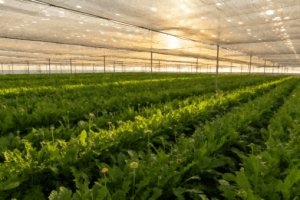
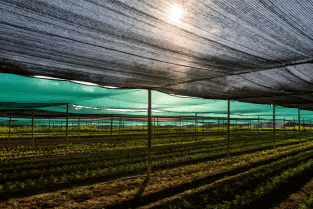
Bulk shade net procurement for commercial agriculture requires a precise analysis of polymer science, textile construction, and microclimate engineering to optimize crop yields and protect industrial-scale investments[cite: 105, 107]. Choosing the right heavy-duty mesh involves evaluating technical parameters—such as raw material density, filament geometry, shade percentages, and structural implementations—to mitigate severe environmental stressors like thermal radiation and wind load[cite: 107, 121, 132]. For enterprise buyers and agricultural distributors, establishing a rigorous selection framework ensures long-term crop protection, operational sustainability, and a high return on investment across multi-acre installations[cite: 59, 153].
Table of Contents
- 1. Technical Distinctions Between Woven and Knitted Shade Netting
- 2. Deconstructing Shade Net Densities and Lighting Dynamics
- 3. Structural Frameworks for Industrial-Scale Installations
- 4. The Functional Impact of Filament Geometry and Color Profiles
- 5. B2B Sourcing Parameters and Quality Control Mandates
- 6. Commercial Procurement Frequently Asked Questions
Technical Distinctions Between Woven and Knitted Shade Netting
Commercial protection textiles are categorized by their underlying structural manufacturing methodology. The choice between woven and knitted mesh configurations dictates the longevity, structural resilience, and tear resistance of the canopy under severe climatic stress[cite: 38, 43]. Woven alternative variations are engineered by interlacing two sets of parallel yarns at right angles, creating a highly structured material with high tensile strength along its linear axes[cite: 43]. However, woven materials lack elastic give and are highly susceptible to unraveling if a single strand is punctured or cut under load, making them less ideal for regions prone to sudden wind gusts or heavy hail.
Conversely, modern industrial facilities utilize precision lockstitch knitting technology to manufacture high-performance panels[cite: 134]. This interlocking filament loop structure prevents line-tear propagation by isolating physical damage to the immediate zone of impact[cite: 132]. The inherent multidirectional elasticity allows knitted configurations to absorb dynamic wind loads efficiently, ensuring durability when deployed on automated rollback or retractable multi-span systems[cite: 44, 46]. As a leading Shade Net manufacturer based in the historic rope netting industrial hub of Lizhuang, China, Xinhang utilizes advanced warp-knitting machinery to provide superior puncture immunity and structural stability across large-scale open-field layouts[cite: 38, 39, 44].
Material Chemistry: High-Density Polyethylene Formulation
The chemical matrix of agricultural mesh determines its resistance to environmental degradation. Industrial-grade High-Density Polyethylene (HDPE) serves as the baseline polymer due to its thermodynamic stability from –40°C to +80°C and its natural inertness against agrochemicals, fertilizers, and sulfur evaporations[cite: 121]. However, pure unreinforced HDPE degrades quickly under constant solar photons, which cleave polymer chains and cause severe micro-cracking[cite: 121, 144]. To counteract this photo-oxidation process, premium commercial netting must be blended with **Hindered Amine Light Stabilizers (HALS)**[cite: 121]. Rather than merely absorbing UV light, HALS acts as a continuous radical scavenger that protects the mechanical properties of the Shade Net for up to five to seven years of continuous outdoor exposure[cite: 121].
Deconstructing Shade Net Densities and Lighting Dynamics
The density percentage of an Agricultural Shade Net represents the ratio of ambient solar radiation blocked by the textile matrix relative to unobstructed daylight[cite: 131, 132]. Matching the density to a crop’s specific light saturation point is essential to maximize Photosynthetically Active Radiation (PAR) and prevent chlorophyll bleaching[cite: 121].
| Shade Density | Target Crop Profiles | Microclimate Functionality |
|---|---|---|
| 30% to 40% | Solanaceae (Tomatoes, Peppers), Cucurbits, Field Flowers | Mitigates peak afternoon temperature spikes while maintaining high PAR transmittance. |
| 50% to 60% | Leafy Greens (Lettuce, Spinach), Brassicas, Nursery Stocks | Reduces moisture transpiration stress, prevents tip-burn, and stabilizes root zones. |
| 70% to 80% | Sciophilic Plants (Orchids, Ferns), Overwintering Protection | Heavy thermal insulation barrier; lowers solar heat flux in high-radiation regions[cite: 121]. |
| 90% | Ginseng, Industrial Privacy Barriers, Livestock Enclosures | Maximum light blocking; provides heavy windbreaks and solar shielding[cite: 43, 121]. |
Photosynthetically Active Radiation and Light Diffusion Physics
Unreinforced standard films or clear materials transmit direct, specular light, which often creates harsh shadows and severe thermal hot spots on the upper canopy while leaving lower leaves under-illuminated. A premium warp-knitted mesh configuration acts as an optical diffusion matrix[cite: 134, 135]. When incoming light hits the high-density filaments, it scatters into diffuse radiation that penetrates deep into the lower structural layers of the crop foliage[cite: 132, 135]. This even distribution stimulates lower-tier leaves, increasing overall net canopy photosynthesis and preventing sunscald.
Thermodynamic Behavior and Microclimate Regulation
By intercepting incoming shortwave solar radiation, the specialized netting alters the microclimate energy balance, lowering plant canopy temperatures by 3°C to 7°C compared to open fields[cite: 121]. Concurrently, the micro-perforated lockstitch geometry permits continuous convective airflow, which vents heat through buoyancy forces while trapping transpiration water vapor[cite: 132]. This interaction stabilizes the **Vapor Pressure Deficit (VPD)**, preventing stomatal closure and keeping plants within their optimal metabolic zone during heatwaves.
Structural Frameworks for Industrial-Scale Installations
Deploying commercial crop protection requires matching the physical properties of the netting with the appropriate structural engineering framework. The mounting method directly impacts wind load distribution and handling efficiency over long operational cycles[cite: 44, 46].
Fixed High-Tunnel Steel Hoop Configurations
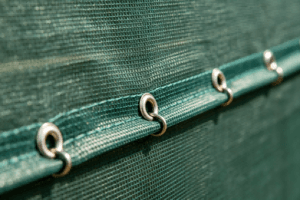
Fixed tunnel structures rely on direct mechanical anchoring over galvanized structural steel frames[cite: 38]. This configuration demands a textile with low structural elasticity to eliminate wind pocketing and water pooling during heavy rainfall[cite: 144]. For these setups, the material must be specified with reinforced selvedges and built-in heavy-duty polymer eyelets to ensure secure load transmission from the flexible fabric to the rigid frame without localized tearing.
Tensioned Cable Suspension Grid Systems
Tensioned cable grids cross extensive acreage by running high-tensile galvanized steel guide wires between reinforced perimeter posts[cite: 43]. This design requires lightweight knitted textiles to minimize mid-span sag[cite: 132]. The panels are secured to the support lines using high-stabilized polymer snap-on clips or specialized metal rings, allowing the mesh to glide smoothly under high wind loads and preventing catastrophic structural failures[cite: 43, 131].
Retractable Motorized Drive Mechanics
Automated operations use motorized torque tubes or push-pull rack systems to adjust shading dynamically based on real-time solar irradiance. This constant movement exerts substantial shear stress along the fabric margins. Consequently, the chosen netting must feature customized, multi-layered polyester web reinforcement bands sewn with UV-stabilized double-lockstitch threads to prevent structural track failures.
The Functional Impact of Filament Geometry and Color Profiles
The filament cross-section and its color profile determine the material’s airflow aerodynamics and the spectral composition of light hitting the crops[cite: 121, 131].
- **Monofilament (Round-Wire) Profiles:** Extruded as solid, round single strands, these lines offer excellent wind resistance by allowing air to slip smoothly through the mesh[cite: 134]. This minimizes lateral force on structural poles and provides superior bursting strength, making them ideal for hail protection and permanent multi-season installations[cite: 43].
- **Tape (Flat-Wire) Profiles:** Extruded as flat ribbons, this geometry maximizes surface coverage per gram of polymer, offering economical light-blocking efficiency[cite: 134, 144]. However, tape profiles create an aerodynamic sail effect under high winds, making them best suited for low-wind fields or interior greenhouse installations[cite: 43].
- **Photo-Selective Color Control:** Utilizing precise masterbatch pigments allows growers to manipulate plant development[cite: 123]. Industrial black systems offer reliable thermal buffers by absorbing solar energy[cite: 121]. Conversely, green variations filter out blue and far-red wavebands to promote vegetative expansion and control internode stretching, while premium white textures maximize diffuse light reflection to keep plants cool[cite: 121, 135].
B2B Sourcing Parameters and Quality Control Mandates
Procuring commercial Outdoor Shade Net rolls requires exact technical verification parameters to ensure field reliability and avoid structural failures[cite: 43, 144].
| Testing Standard | Minimum Threshold | B2B Quality Significance |
|---|---|---|
| Mass Per Area Ratio (GSM) | Target Density ± 5% (e.g., 50g–120g/m2) [cite: 134] | Ensures appropriate polymer deployment; prevents over-stretching during manufacturing[cite: 144]. |
| Tensile Strength (ASTM D5034) | Warp: ≥ 450 N | Weft: ≥ 350 N | Prevents tearing along mechanical stress lines under sustained wind loading[cite: 144]. |
| Bursting Strength (ASTM D3786) | ≥ 1.8 MPa | Guarantees impact resistance against hail, flying debris, and wildlife[cite: 43, 121]. |
| Dimensional Shrinkage Rate | < 1.5% at 60°C exposure | Eliminates unexpected roll shrinkage, keeping the target plant canopy fully covered[cite: 144]. |
As an integrated manufacturing group with an established factory matrix, Xinhang guarantees strict compliance with verified manufacturing standards[cite: 38, 47]. We test every batch for mass density, tensile limits, and light-blocking consistency, ensuring commercial farms receive uniform protection across every hectare[cite: 44, 132].
Commercial Procurement Frequently Asked Questions
Q1: How can enterprise buyers differentiate between a true manufacturer and a trading company during sourcing?
True manufacturers maintain complete control over raw material compounding and extrusion parameters[cite: 43]. A professional factory can provide raw resin certification, independent UV chamber aging reports, and verified GSM mass charts[cite: 44, 134]. Trading entities usually sell standard size rolls with generic descriptions and are typically unable to customize chemical additive packages, such as increasing HALS content for high-UV regions[cite: 44, 121, 141].
Q2: What is the primary cause of premature netting failure in commercial structures?
Most premature failures result from mechanical chafing rather than direct chemical UV degradation. When a canopy is loose, wind causes the fabric to rub continuously against structural posts or wires[cite: 43, 144]. This friction wears through polymer filaments, highlighting the importance of using professional tensioning hardware and reinforced edges[cite: 43].
Q3: Why does a black canopy panel often radiate more heat than a white panel of identical density?
This difference stems from the optical behavior of the pigments. Carbon black absorbs wavelengths across the visible and infrared spectrum, turning solar radiation into thermal energy within the net filaments[cite: 121]. White systems utilize titanium dioxide to reflect and scatter near-infrared radiation, allowing the fabric to remain significantly cooler under identical sunlight conditions[cite: 121].
Q4: What is the recommended off-season storage protocol for multi-season commercial netting?
Before storing, panels should be washed with clean, low-pressure water to remove accumulated dust, agrochemical residues, and organic matter[cite: 121, 144]. Once fully dry, roll the nets tightly onto dry cores, wrap them in UV-opaque protective film, and store them horizontally in a cool, pest-free warehouse to prevent creases and extend their operational lifespan[cite: 43, 121].
References & Industry Standards:
- ASTM D5034 Standard Test Method for Breaking Strength of Textile Fabrics: Greenhouse Megastore Technical Materials Database
- Agricultural Microclimate and Thermal Engineering Metrics: Farm Plastic Supply Crop Protection Review
- Lockstitch Polymer Manufacturing Controls: Greenpro Ventures Textile Analysis