Selecting the best commercial Shade Net for patios and outdoor nursery areas requires bridging the gap between horticultural microclimate control and high-end architectural aesthetics. For commercial spaces—such as retail garden centers, restaurant patios, and luxury resort nurseries—the chosen fabric must provide precise Photosynthetically Active Radiation (PAR) diffusion to protect delicate ornamental plants, while simultaneously delivering a cool, visually pleasing environment for human patrons. The optimal solution is a heavy-duty, lockstitch knitted matrix extruded from 100% virgin High-Density Polyethylene (HDPE). Specifically, commercial buyers should target a 70% to 80% density configuration utilizing specialized tape-and-monofilament hybrid yarns. This specification guarantees maximum thermal reduction, superior aerodynamic wind resistance, and long-term structural elegance without the rapid UV degradation seen in retail-grade residential canopies.
Table of Contents
- 1. Dual-Purpose Design: Balancing Plant Physiology and Human Comfort
- 2. Defining the Optimal Density: The 70% to 80% Standard
- 3. Structural Topography: The Hybrid Knit Advantage
- 4. Color Selection and Architectural Integration
- 5. Commercial Procurement Parameters and Edge Engineering
- 6. Commercial Patio and Nursery Frequently Asked Questions (FAQ)
Dual-Purpose Design: Balancing Plant Physiology and Human Comfort
Unlike isolated agricultural fields where yield is the sole objective, commercial patios and retail nurseries serve a dual function. They must sustain living inventory while providing a comfortable, premium experience for retail customers or dining patrons.
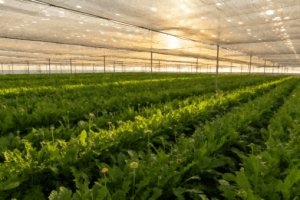
From a botanical perspective, the retail nursery environment is highly stressful. Plants are typically held in small, black plastic nursery pots resting directly on heat-absorbing gravel or concrete. These conditions elevate the soil temperature rapidly, leading to extreme root stress and accelerated transpiration. The overhead canopy must intercept harsh, specular sunlight and convert it into soft, diffuse radiation, preventing photoinhibition and foliar bleaching on high-value ornamental stock.
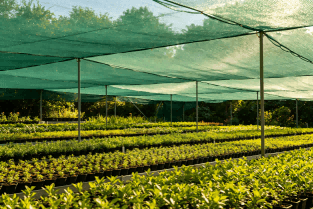
Simultaneously, the fabric must act as a thermodynamic buffer for humans. Solid canvas awnings or PVC roofs trap rising hot air, creating a suffocating greenhouse effect beneath the patio structure. A high-grade Outdoor Shade Net utilizes a micro-perforated matrix. This porosity allows continuous convective airflow; rising hot air naturally vents up and out through the lockstitch apertures, dropping the ambient temperature in the shaded zone by up to 10°C to 15°C compared to direct sunlight, drastically improving customer dwell time.
Defining the Optimal Density: The 70% to 80% Standard
Selecting the correct fabric density is the most critical calculation for mixed-use commercial spaces.
- Low Densities (30% to 50%): While excellent for high-volume agricultural crop growth, these densities allow too much intense UV radiation and solar heat to pass through. Customers sitting beneath a 40% net will still squint and feel uncomfortably hot, while shade-loving ornamental plants (like hostas or ferns) will burn.
- Ultra-High Densities (90% to 95%): These privacy-grade meshes block almost all light. While they provide maximum cooling, they create an excessively dark environment, making retail displays look gloomy and starving understory plants of necessary Daily Light Integral (DLI).
- The 70% to 80% Sweet Spot: This range is the commercial standard for retail nurseries and patios. It provides profound thermal relief and heavy UV blockage to protect human skin, while still transmitting 20% to 30% of diffuse PAR photons—the exact threshold required to keep broadleaf ornamentals, tropicals, and flowering baskets vibrant and healthy during their retail shelf-life.
Structural Topography: The Hybrid Knit Advantage
The physical structure of the polymer yarn determines how the canopy interacts with severe weather events. Retail environments cannot afford sudden infrastructure failures or unsightly ripped fabrics. Therefore, woven fabrics—which lack elasticity and unravel rapidly if punctured—must be avoided. The absolute requirement is a lockstitch knitted matrix.
Within knitted structures, commercial operators should specify a Hybrid Tape-and-Monofilament extrusion:
1. Round Monofilament Warp Yarns: The primary structural lines running the length of the fabric must be extruded as solid, cylindrical HDPE monofilaments. Round yarns possess the highest hydraulic bursting strength and minimal aerodynamic drag, allowing the patio canopy to survive severe wind shear and sudden hail impacts without snapping.
2. Flat Tape Weft Yarns: The horizontal interlacing yarns are extruded as flat ribbons. These flat tapes maximize the surface area coverage of the fabric, generating the dense 80% shade barrier required for cooling, while simultaneously keeping the overall weight of the panel low to prevent sagging over large patio spans.
Color Selection and Architectural Integration
For commercial spaces, color selection transcends mere agronomics; it directly impacts brand identity and customer psychology. The chosen pigment alters both the visual ambiance and the radiometric behavior of the shaded zone.
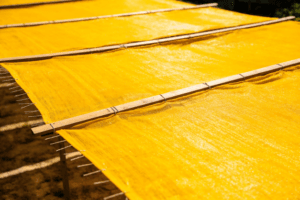
- Architectural Desert Sand / Beige: The premier choice for high-end hospitality patios and modern retail centers. Beige reflects a significant portion of solar near-infrared (NIR) heat while casting a warm, flattering, naturally diffused light downward. It blends seamlessly with wood, stone, and premium landscaping.
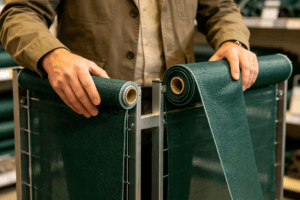
- Classic Forest Green: The standard for dedicated retail nurseries. Green meshes act as a photo-selective filter, lowering the Red to Far-Red (R:FR) ratio. This spectral shift deepens the chlorophyll pigmentation in the plants below, making retail foliage look extraordinarily lush and healthy to consumers.
- Industrial Black: While highly durable due to carbon black’s natural UV resistance, black netting absorbs massive amounts of heat. If installed over a low-ceiling patio, it can radiate that thermal energy downward onto patrons. Black should only be used on very high-clearance architectural structures where heat can easily vent away.
Commercial Procurement Parameters and Edge Engineering
Residential-grade shade cloths purchased from big-box hardware stores are manufactured from recycled plastics and lack structural borders, leading to rapid photo-oxidation and edge fraying within a single summer. Enterprise operations require industrial procurement standards to protect their capital investment.
As a verified Shade Net manufacturer located in Lizhuang, the historic epicenter of China’s technical netting industry, Xinhang guarantees that all architectural canopies are extruded from 100% Virgin HDPE. This pure polymer base is heavily compounded with Hindered Amine Light Stabilizers (HALS), neutralizing UV-generated free radicals and securing a 5 to 7-year colorfast, structural lifespan.
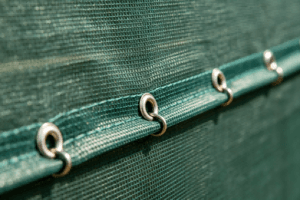
Crucially, commercial patio installations require heavy mechanical tension to prevent aerodynamic flutter. Xinhang processes all custom commercial orders with heavy-duty selvedge edge reinforcement. We fold and sew multi-layered polyester webbing along all borders using UV-stabilized thread, and embed rust-proof brass grommets spaced to the millimeter. This factory finishing ensures that the immense tensile load is distributed evenly across the canopy framework, delivering a flawless, drum-tight architectural aesthetic without the risk of tear-outs.
Commercial Patio and Nursery Frequently Asked Questions (FAQ)
Q1: Will an 80% shade net block rain from ruining my commercial patio?
No. Standard knitted shade netting is designed to be highly porous to allow convective heat venting. While an 80% dense net will break up heavy raindrops into a fine mist, it will not keep the area completely dry during a downpour. If 100% waterproofing is required, you must procure a specialized PVC-coated waterproof membrane, though this will sacrifice airflow and trap heat.
Q2: Why is my current retail shade cloth sagging in the middle of my patio structure?
Sagging occurs for two reasons. First, the material may lack inherent elasticity (a common issue with cheap woven fabrics) or was installed without applying a negative tension allowance. Second, low-quality nets suffer from thermal expansion; when heated by the sun, the polymer stretches and sags. High-grade commercial nets from true manufacturers are heat-set to ensure dimensional stability and must be stretched drum-tight during installation.
Q3: Is a white shade net a good choice for a restaurant patio?
White nets are exceptional at reflecting thermal heat and keeping the area cool. However, bright white netting can create a harsh, glaring visual environment that causes eye strain for patrons under intense midday sun. For hospitality environments, “Desert Sand” or beige offers the same cooling reflection while casting a much softer, more comfortable ambient light.
Q4: How do I clean a commercial shade canopy deployed over a retail center?
Dust, pollen, and bird droppings will accumulate over time. Clean the canopy using a low-pressure water stream and a soft-bristled brush with a mild, non-abrasive detergent. Never use high-pressure power washers, as the intense PSI will physically slice through the polymer micro-threads and strip away the external UV stabilizers.
Q5: How can I verify that the net I am buying will not disintegrate from UV exposure next year?
Demand transparency from the supplier. Specify that the net must be extruded from 100% Virgin HDPE (no recycled regrind) and ask for documentation confirming the inclusion of Hindered Amine Light Stabilizers (HALS). Legitimate commercial manufacturers will gladly provide technical data sheets and QUV accelerated weathering test results backing a 5+ year warranty.
References & Architectural Standards:
- Architectural Shade Geometry and Thermal Venting: Shade Cloth Store Custom Engineering
- Nursery Microclimate and Daily Light Integrals: Greenhouse Megastore Horticultural Reports
- HDPE Polymer Tensioning and Edge Reinforcement: Farm Plastic Supply Installation Protocols