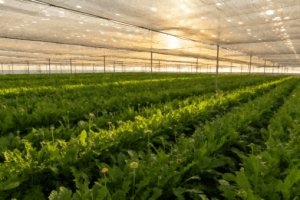
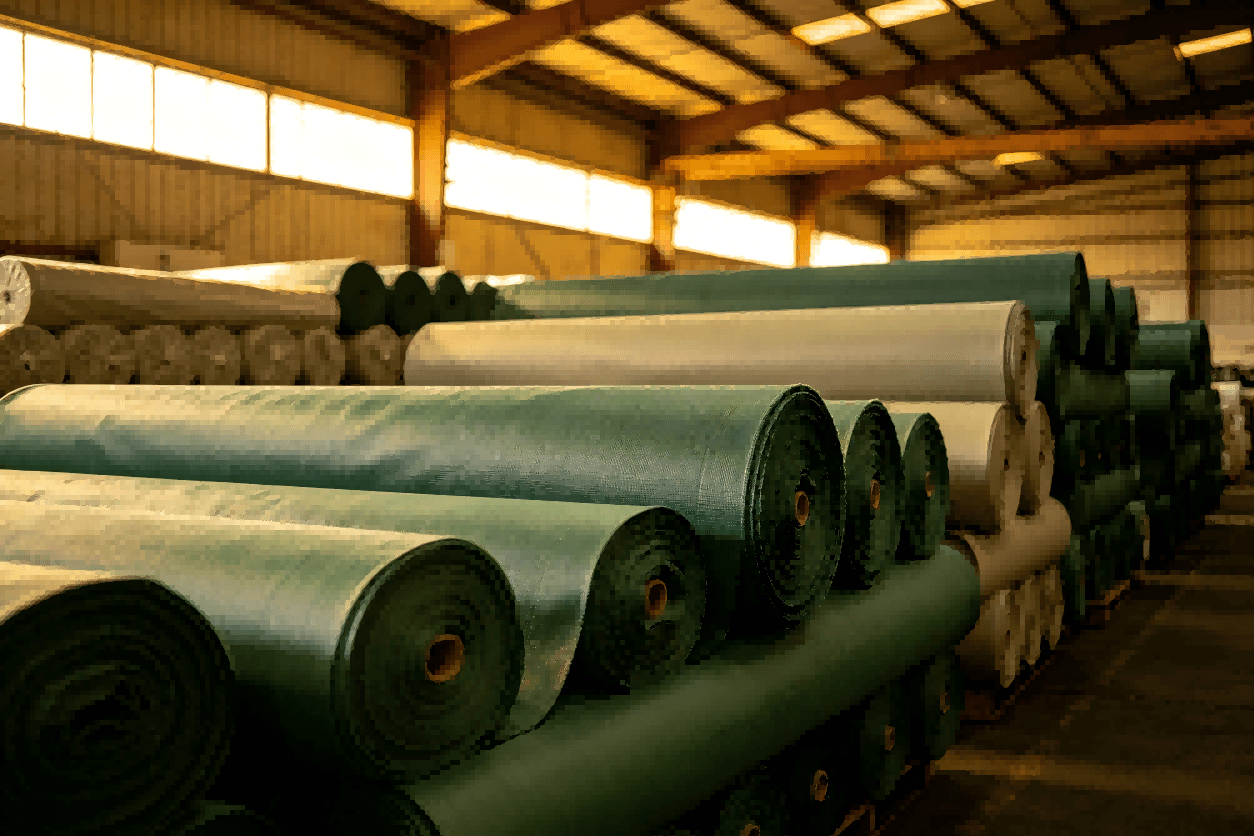
Custom size Shade Net procurement for B2B applications requires a rigorous technical specification process that accounts for structural dimensions, polymer elasticity, and factory-finished reinforcement requirements. B2B buyers often face substantial material waste and structural failure when attempting to adapt generic, off-the-shelf rolls to unique agricultural or industrial frameworks. To guarantee project success, enterprise procurement must shift toward custom-fabricated modular panels—pre-shrunk, edge-taped, and grommet-aligned to exact CAD specifications—directly from the primary production source. By integrating negative tension allowance calculations and verifying High-Density Polyethylene (HDPE) quality standards before manufacturing, industrial operations can eliminate on-site cutting waste, slash installation labor costs, and secure a multi-year, weather-resistant canopy.
Table of Contents
- 1. Why Generic Roll Procurement Fails Enterprise Projects
- 2. Defining the Technical Specification Package
- 3. Geometry and Elasticity: The Math of Custom Panels
- 4. Edge Engineering: Selvedges, Webbing, and Grommets
- 5. Commercial Data: Waste Reduction and ROI Matrix
- 6. Sourcing from the Source: Manufacturer Direct vs. Trading
- 7. Procurement FAQ for B2B Buyers
Why Generic Roll Procurement Fails Enterprise Projects
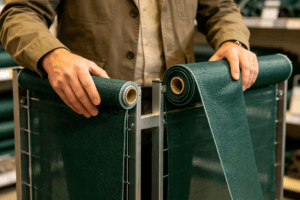
Commercial projects—such as massive multi-span greenhouses, industrial mining dust barriers, or luxury patio canopies—are inherently unique. Relying on standard 50-meter rolls forces on-site laborers to manually cut, overlap, and improvise attachments, which is the most frequent cause of project failure.
Manual cutting in the field destroys the structural integrity of the fabric’s reinforced selvedge. Once the factory-sealed edge is broken, the net becomes highly susceptible to line-tear propagation under high-wind conditions. Furthermore, field-improvised seams and attachment points cannot withstand the concentrated shear forces of a large-scale installation. For enterprise-level projects, the hidden cost of wasted material and increased labor hours often renders generic roll procurement more expensive than custom-fabricated panels.
Defining the Technical Specification Package
To receive a precise, high-performance product from an Agricultural Shade Net factory, the buyer must provide a comprehensive technical specification package (TSP). A complete TSP includes:
- Dimensional CAD Drawings: Precise structural footprint measurements rather than just ground area.
- Polymer Specification: 100% Virgin HDPE base resin, compounded with Hindered Amine Light Stabilizers (HALS) for UV protection.
- Density and Mass: Verified GSM (Grams per Square Meter) correlating with the desired shade percentage.
- Reinforcement Profile: Multi-layered polyester webbing tape width and specified grommet spacing (typically 50 cm).
Geometry and Elasticity: The Math of Custom Panels
Successful procurement starts with correct geometric modeling. For example, when covering a Quonset hoop structure, buyers must account for the arc length of the hoop, not the ground width.
Crucially, enterprise buyers must apply a tension allowance. Because a warp-knitted mesh is elastic, ordering the exact frame dimension will result in a baggy, fluttering canopy that catches wind and tears. Engineers calculate a 1.5% to 3% negative allowance. If the structural span is 100 meters, the fabric is custom-manufactured to 97.5 meters. The installation team then stretches this shorter panel to fit, creating a drum-tight, aerodynamically stable canopy that resists flutter-induced fatigue.
Edge Engineering: Selvedges, Webbing, and Grommets
The edge of the panel is the primary load-bearing point. Generic netting lacks the structural reinforcements necessary for industrial tension. When ordering custom panels from an Shade Net manufacturer, specify the following:
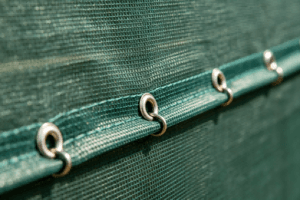
- Webbing Tape: Specify multi-layered polyester webbing, typically 5 cm to 8 cm in width, sewn along all four sides with UV-stabilized, heavy-duty thread.
- Grommet Configuration: Brass or high-grade stainless steel eyelets should be punched through the webbing—never through raw mesh. Specify a 50 cm spacing for high-wind locations to ensure the structural tension is distributed across the entire support cable grid.
Commercial Data: Waste Reduction and ROI Matrix
The transition from generic roll procurement to custom-fabricated B2B procurement results in measurable improvements in operational efficiency.
| Procurement Metric | Generic Roll Strategy | Custom Panel Strategy |
|---|---|---|
| On-Site Material Waste | 10% – 15% (Cutting and seam overlap loss). | < 1% (Precision factory fabrication). |
| Installation Labor Time | High (Measuring, cutting, sewing on-site). | Low (Plug-and-play panel hoisting). |
| Structural Reliability | Low (Risk of edge fraying and blowout). | High (Factory-verified edge reinforcement). |
| Lifespan in Extreme Wind | 1 – 2 Seasons. | 5 – 10 Years. |
Sourcing from the Source: Manufacturer Direct vs. Trading
To prevent product quality dilution, enterprise project managers must audit their supply chain. Trading companies frequently provide inconsistent materials and lack the manufacturing capacity to execute the custom edge reinforcements and exact tension allowances required by professional structural engineers.
Xinhang, as an integrated Shade Net manufacturer based in the industrial center of Lizhuang, China, offers an integrated procurement advantage. We own the warp-knitting machinery, the chemical compounding extruders, and the heavy-duty precision sewing lines. This vertical integration allows us to take your architectural CAD drawings and produce finished, tension-ready panels that fit your structure perfectly. By sourcing from Xinhang, you eliminate middlemen, verify polymer quality from resin to roll, and receive an engineered canopy solution that guarantees multi-year performance.
Frequently Asked Questions (FAQ) for B2B Buyers
Q1: How do I handle large-scale geometric shapes that are not simple rectangles?
For non-rectangular designs, such as triangular canopies or irregular multi-span roofs, it is critical to provide the factory with precise CAD coordinates or vertex measurements. The manufacturer will use this data to calculate the pattern, allowing for precision factory-seaming of panels that result in a seamless, structurally secure shape without on-site cutting.
Q2: What is the benefit of “True-Width” extrusion for large orders?
True-width manufacturing means the net is extruded, annealed, and heat-set to its target width from the start. This prevents the “stretched-width” fraud, where narrow rolls are mechanically stretched to appear wider. True-width panels are dimensionally stable, meaning they won’t shrink and snap their attachment hardware when exposed to the high heat of a summer installation.
Q3: How do I calculate the correct tension allowance for my project?
This depends on the specific knit type and polymer density. Generally, a 1.5% to 3% negative allowance is standard for warp-knitted HDPE. When drafting your specification package, provide the factory with your total structural span, and request a factory consultation to calculate the exact reduction based on the specific netting product you have selected.
Q4: Can I request flame-retardant (FR) treatments for custom panels?
Yes. For construction, public malls, or high-density retail spaces, you must specify FR-treated netting that meets regional fire safety codes (like NFPA 701). This chemical treatment must be integrated into the extrusion process to ensure the flame-retardant properties remain permanent throughout the canopy’s lifespan.
Q5: What is the best way to package and ship custom-sewn panels?
Custom panels are typically folded or rolled into compact, moisture-proof transport bags based on the project phase. Clearly label each panel bag with its architectural location (e.g., “North Span 3”) to allow the installation crew to deploy the panels sequentially without wasting time unwrapping the wrong piece.
References & Industrial Procurement Standards:
- CAD Modeling and Tension Specification Guidelines: Shade Cloth Store Procurement Specs
- Polymer Density and Structural Load Verification: Greenhouse Megastore Engineering Data
- Warp-Knitting Elasticity and Installation Allowances: Farm Plastic Supply Field Implementation